Donor Bridge — ending duplicate donors for good
A nonprofit was losing track of its own donors, splitting giving histories across two disconnected systems every time staff re-entered data by hand. We built an identity-matching engine that recognizes returning donors automatically, syncs records between platforms, and routes anything uncertain to a human for approval before it ever touches the database.
Ask anyone who manages data at a nonprofit about their donor database and you will usually hit a nerve. Somewhere in that database are duplicates: the same generous person entered three times under slightly different details, their giving history split across all three, the thank-you letters going out twice, the reporting quietly wrong. It is one of the most common and most frustrating problems in nonprofit operations, and it almost always traces back to the same root cause, moving donor data between systems by hand.
Donor Bridge was built to stop that problem at the source. It is a data synchronization platform that connects two systems many nonprofits rely on, Classy for online fundraising and DonorPerfect for donor management, and moves donor and donation data between them automatically and cleanly. This is the story of the engineering behind it, where the contribution spanned the full stack, building the integration workflows, the synchronization APIs, the data storage, and the automation and monitoring that keep it all running.
The Problem Between Two Systems
Many nonprofits run their fundraising campaigns through one platform and keep their official donor records in another. Classy handles the online giving, DonorPerfect holds the database of record. On paper that division makes sense. In practice it creates a gap, and someone has to bridge that gap, usually by manually copying donations from one system into the other.
That manual transfer is where the trouble starts. It is slow, it pulls staff away from the actual mission, and worst of all it breeds duplicates. When a returning donor gives again, a person re-entering that gift may not realize the donor already exists, and a second record gets created. Multiply that across hundreds of donations and the database steadily degrades. Donor Bridge was built to close the gap automatically, moving the data without the manual effort and, crucially, without the duplicates.
What Donor Bridge Does
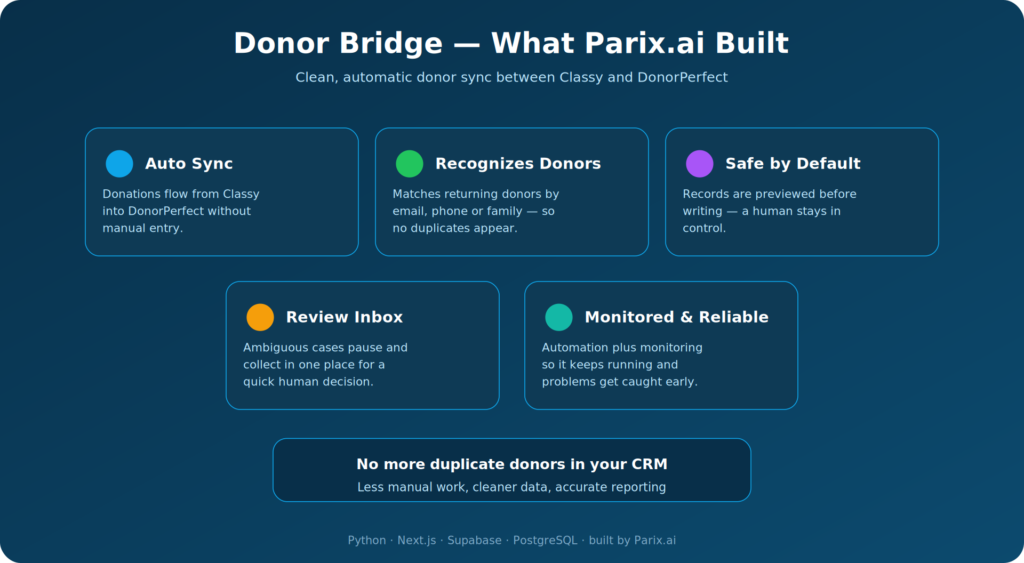
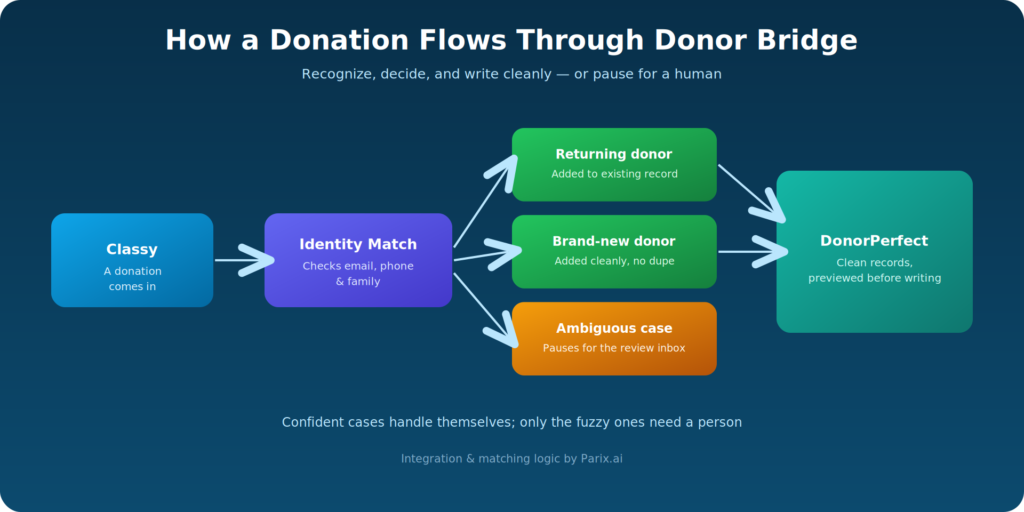
At its core, Donor Bridge lets donations flow automatically from Classy into DonorPerfect, but the clever part is how it handles the people behind those donations. Every returning donor is recognized so their gift is added to the record that already exists, every genuinely new donor gets added cleanly, and any ambiguous case, where the system is not sure, pauses for a human to look at rather than guessing.
That last part is what makes it trustworthy. A lot of integrations take an all-or-nothing approach: either they blindly create records, duplicates and all, or they demand a human check everything. Donor Bridge threads the needle. It handles the clear cases automatically and only asks for human judgment on the genuinely fuzzy ones, which is exactly where human judgment is actually worth spending.
The Recognition That Prevents Duplicates
The heart of the platform is its ability to recognize whether a donor already exists before it writes anything. It catches returning donors quickly by matching on details like email, phone, and family connections, so a person who has given before is identified as the same person rather than entered again as a stranger. This identity matching is the whole reason duplicates never get created in the first place.
Matching people reliably is genuinely hard, because real-world data is messy. The same donor might use a different email this time, or a nickname, or be part of a household that should be linked rather than split. By matching on several signals at once instead of relying on a single field, the system can recognize the same person even when the details do not line up perfectly. Getting that matching logic right is the difference between a tool that quietly cleans up your data and one that quietly makes the duplicate problem worse.
Safe by Default
When a system is writing to your official donor database, trust is everything, and Donor Bridge is built to be safe by default. Records are previewed before they are written into DonorPerfect, so a human stays in control of what actually lands in the database rather than discovering surprises after the fact. Nothing important happens silently.
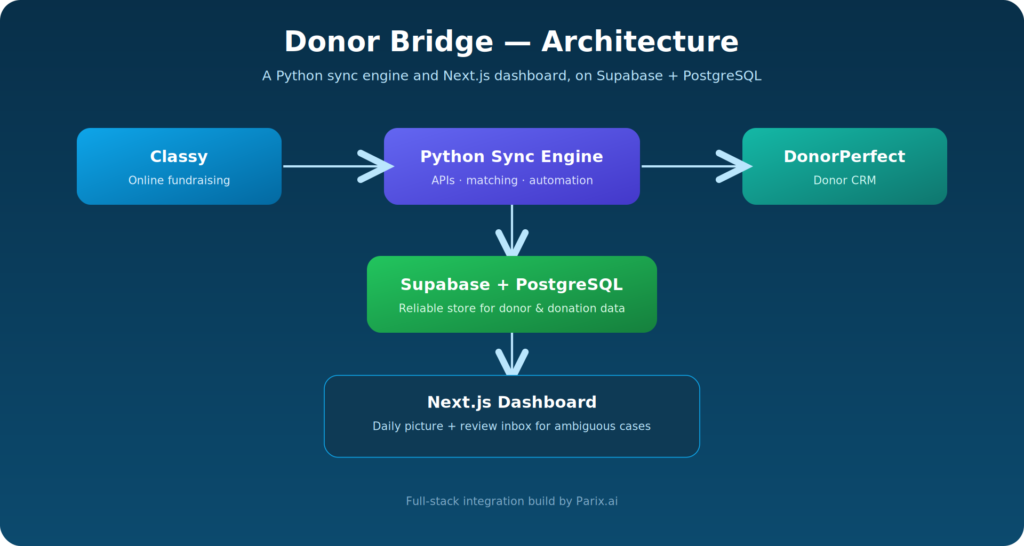
That philosophy carries into how the day-to-day works. There is one simple screen for the daily picture of what is flowing through, plus a review inbox that collects anything fuzzy for a person to resolve. It is a deliberately calm way to run something powerful: the routine, confident cases handle themselves, while the handful of uncertain ones are gathered in one place for a quick human decision. The result is automation that a cautious nonprofit can actually trust with its most important data.
The Integration Engine Underneath
Making two separate platforms talk to each other reliably is the unglamorous core of the whole project. A big part of the work was building the integration workflows between Classy and DonorPerfect, along with the APIs that actually carry donor and donation data from one to the other. This is the plumbing that everything else depends on, and it has to be solid.
Integration work is detailed and exacting. Each platform has its own way of structuring data and its own rules, and the synchronization APIs have to translate cleanly between them so a donation in Classy becomes the right record in DonorPerfect every time. When this layer is built well, the whole thing feels effortless, data simply appears where it should. When it is built poorly, you get exactly the mess Donor Bridge was created to prevent. Getting these workflows and APIs right is what turns the idea into a dependable product.
Keeping It Running and Watching It
A synchronization platform is not something you build and walk away from, it has to keep running quietly and reliably, day after day. Part of the work was implementing the automation and monitoring features that make that possible. The automation is what lets donations flow without anyone pushing a button, and the monitoring is what gives confidence that it is actually working.
Monitoring matters more than it might seem. With a system handling important data between two platforms automatically, you need to know it is healthy, and you need to catch any problem early rather than discovering weeks later that something stopped syncing. Building in that visibility is what makes the platform safe to depend on, the difference between an automation you trust and one you nervously check by hand anyway.
The Stack Underneath
The technology fits the job well. Python powers the backend sync engine, a natural choice for the kind of data processing and integration work at the heart of the platform. The interface is built in Next.js, giving the daily dashboard and the review inbox a clean, responsive feel so the people using it can get the picture at a glance.
For data, the platform uses Supabase alongside PostgreSQL, a combination that pairs a reliable, structured database with a modern developer experience for building on top of it. Donor and donation data is exactly the kind of structured, relational information PostgreSQL handles dependably, which matters a great deal when the whole point of the product is accuracy. It is the same full-stack engineering and integration mindset behind our other automation work, including the ecommerce operations project.
Why It Matters
Donor Bridge solves a problem that is unglamorous but genuinely costly. Duplicate donor records and manual data entry drain time, muddy reporting, and erode the donor relationships nonprofits work so hard to build. Quietly fixing that, by moving data automatically and keeping it clean, frees nonprofit teams to spend their energy on their mission instead of on database housekeeping.
It is also a strong example of integration done thoughtfully. Connecting two established platforms, matching identities reliably, and doing it all safely enough that an organization will trust it with their most important records is harder than it looks. For any business or nonprofit struggling to keep data in sync between the systems they depend on, Donor Bridge shows what a well-built bridge can do. If that sounds familiar, it is an easy conversation to start. Get in touch with Parix.ai here.
Before and After
Before
- Every donation was re-typed by hand from Classy into DonorPerfect
- Returning donors were often entered again as new records, splitting their giving history across duplicates
- Thank-you letters went out twice to the same person
- Reporting was quietly wrong, because the records underneath it were wrong
After
- Donations move from Classy into DonorPerfect automatically, with no manual re-entry
- Returning donors are matched on email, phone and household connections, so a gift attaches to the record that already exists
- Anything ambiguous pauses and goes to a review inbox for a person to decide, rather than being guessed
- Records are previewed before anything is written to the donor database
The Outcome
The manual step that created the duplicates no longer exists. Donations move between the two systems on their own, and a returning donor is recognised before anything is written.
The design decision that made this usable was refusing to pick between blind automation and checking everything by hand. Clear cases are handled automatically. Only genuinely uncertain ones reach a person, which is exactly where human judgment is worth spending.
Because records are previewed before they land in DonorPerfect, nothing important happens silently. That is what makes a cautious organisation willing to let a system touch its most important data at all — and it is the difference between an automation a team trusts and one they nervously double-check by hand anyway.
Ready to streamline your operations?
Parix.ai helps growing businesses identify repetitive tasks, improve workflow visibility, and build smarter systems that save time as the business scales.
Talk to Parix.ai