
Khato — software that speaks the language its users actually use
Cotton and fertiliser traders in interior Sindh had no accounting software built for them — everything on the market assumed English and constant internet. We built an offline-first ledger app entirely in Sindhi, syncing to the cloud when connected, replacing a paper register with software people can actually read.

Walk into a fertilizer or cotton trader’s shop anywhere in interior Sindh and you will almost always find the same thing on the counter: a thick, well-worn register. The khata. Every sale, every payment, every sack of urea that went out on credit, all of it written by hand, in Sindhi, in a book that holds the entire memory of the business. It works, in the way that things that have worked for generations do. But it is also fragile, slow to total up, impossible to back up, and useless the moment that one book goes missing.
Khato was built to bring that register into the modern age without asking the trader to change who they are or what language they think in. It is an offline, Sindhi-language ledger, inventory, and accounting system made specifically for fertilizer and cotton traders, with customer and supplier khata management, stock tracking, automated cloud sync, and a secure web dashboard for keeping an eye on the business from anywhere. It was built end to end in the role of full-stack developer and UX designer, and this is the story of how it came together.
The Problem With Off-the-Shelf Software
For a trader in this world, the existing options are a poor fit, and it is worth being honest about why. Most accounting software is in English, which immediately shuts out a huge number of the people who would benefit from it most. Most of it also assumes a steady internet connection, which is a shaky assumption in many of the rural areas where these businesses operate. And most of it is built for generic bookkeeping, not for the specific rhythms of buying and selling fertilizer and cotton on credit.
The result is that most traders simply do not use software at all. They stick with the paper register, not because they are resistant to technology, but because nothing on offer actually speaks their language or fits their reality. Khato started from that gap. The goal was not to build another generic accounting tool, but one shaped so closely around these traders that adopting it would feel less like learning a system and more like upgrading the book they already trust.
Built in Sindhi, From the Ground Up
The single most important decision in the whole project was language. Khato is built entirely in Sindhi, and not as an afterthought translation bolted onto an English app. The interface, the labels, the modules, the empty-state hints, all of it reads naturally in Sindhi and flows right-to-left the way the language is meant to. For the person using it, the software feels like it was made for them, because it was.
This is harder than it sounds and matters more than it gets credit for. Designing a clean, modern interface that works properly right-to-left, with Sindhi text sitting comfortably alongside numbers and icons, is a real UX and design challenge. Get it slightly wrong and the whole thing feels awkward and foreign. Get it right, as Khato does, and a trader who has never touched accounting software can sit down and understand what they are looking at within seconds. That accessibility is not a feature on a list. It is the entire reason the product can exist for this audience.
The Whole Business at a Glance
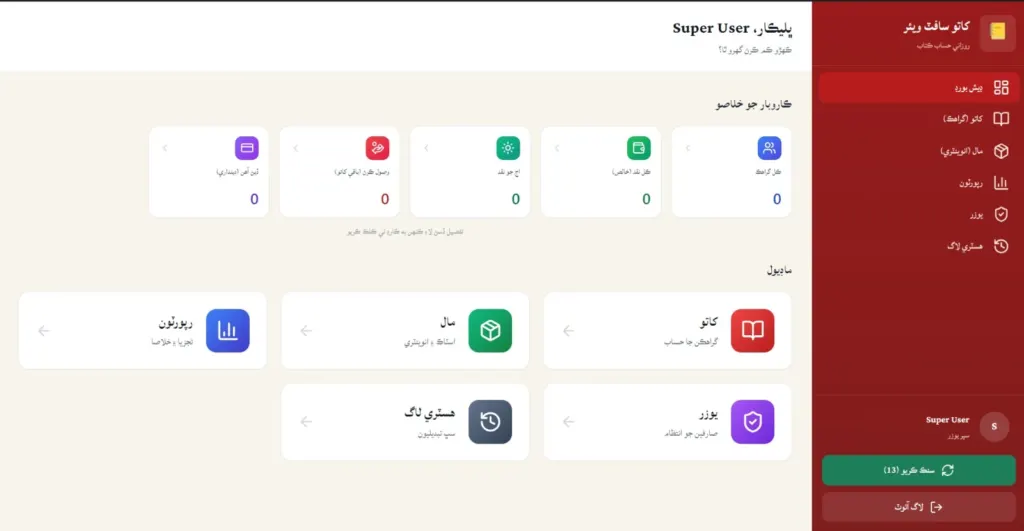
Open Khato and the first thing you see is a dashboard that sums up the state of the business in a single screen. The top of the page carries the numbers that matter most to a trader day to day: what is owed out, what is still to be collected, the cash taken today, the total cash position, and the total number of customers. Below that sit the modules, the main areas of the app, laid out as clear, tappable cards: accounts, inventory, reports, users, and a history log.
The thinking here is that a trader should not have to go hunting to understand where they stand. The information they would otherwise have to tally by hand from the register is simply there, calculated and waiting, the moment they open the app. Everything else is one clear step away. It is a calm, uncluttered starting point for a business that, on paper, lives in a tangle of scattered entries.
Digitizing the Khata
At the heart of Khato is the khata itself, the account-keeping that is the core of how these businesses run. The accounts module handles the relationships a trader has to track: customers, banks, companies, and sets, each kept in its own clean list. For every one, Khato keeps the running figures that the paper register makes you add up by hand, the total number of accounts, what is outstanding, the totals, and the net amount.
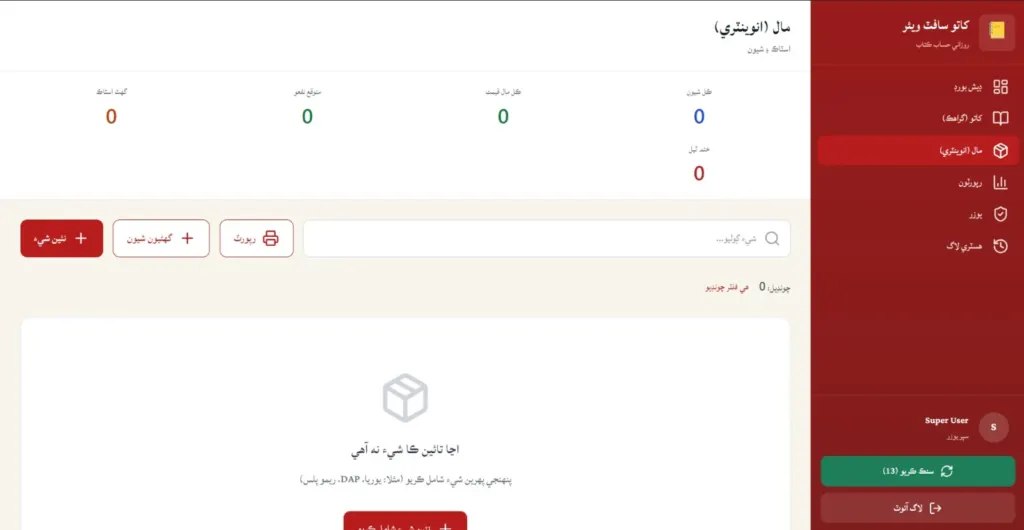
This is where the leap from paper becomes obvious. In a register, finding one customer’s full history means flipping through pages and adding figures in your head. In Khato , a customer is a record you can pull up instantly, with their balance already calculated. Adding a new customer, a bank, or a company takes a couple of taps, and a report is always one button away. It takes the most important and most error-prone part of the trader’s work, knowing exactly who owes what, and makes it reliable.
Keeping Track of the Stock
Alongside the accounts sits a full inventory module, because for a fertilizer and cotton trader the stock is the business. Khato tracks the things on the shelves, the urea, the DAP, and the rest, and surfaces the numbers a trader actually needs to make decisions: the total number of items, the total value of the stock, the expected profit, and warnings for what is running low or has run out entirely.
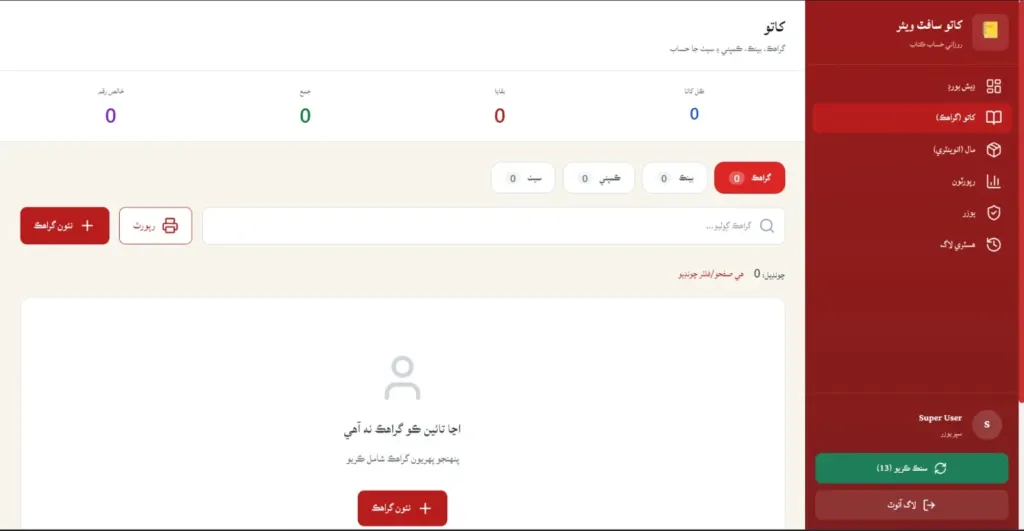
Those low-stock and out-of-stock warnings are a small touch that does real work. A trader who can see at a glance that they are about to run out of a fast-moving product can reorder before they lose a sale, rather than finding out when a customer asks for something that is not there. Adding items is quick, whether one at a time or in bulk, and as with the accounts, a report is never more than a click away. It turns stock-keeping from a guessing game into something the trader can actually see.
Offline First, Because the Internet Is Not Always There
This is the decision that makes Khato genuinely suited to its world. The app is offline-first, built as a desktop application that keeps its data locally so it works perfectly with no internet connection at all. A trader in an area with patchy or no connectivity can run their entire business on it, all day, without a single interruption. The software never stops working just because the network does.
But offline does not mean isolated. Khato also does automated cloud synchronization, so when a connection is available, the local data quietly syncs up to the cloud. You can see this on the screen as a sync control that shows how many changes are waiting to go up. This gives the trader the best of both worlds: the rock-solid reliability of a local, offline app, with the safety and reach of the cloud. The register can never again simply go missing, because a copy lives safely online. It is the kind of automated, behind-the-scenes process that the user never has to think about, which is exactly how it should be.
Watching the Business From Anywhere
That cloud sync unlocks one more thing: a secure web dashboard. Because the data makes its way to the cloud, the business can be monitored in real time from any device, not just the computer the desktop app runs on. An owner who is away from the shop, or who runs more than one location, can check in on how things are going from a phone or a laptop wherever they are.
This bridges a gap that paper never could. A register sits in one place, and to know what it says you have to be standing in front of it. Khato frees that information, securely, so the people responsible for the business can stay connected to it without being physically tied to the counter. For a growing trader, that reach is the difference between a shop and an actual, manageable business.
The Stack Behind It
Pulling all of this off, offline desktop app, cloud sync, and web dashboard at once, took a thoughtfully chosen stack. The desktop application is built with Electron, which is what lets a modern web-style interface run as a proper installable program on a trader’s computer. The interface itself is built with Next.js, React, TypeScript, and Tailwind CSS, the same modern toolset behind high-quality web apps, which is how Khato manages to look clean and current rather than like dated accounting software.
Underneath, Node.js and Express.js power the backend and the APIs that tie everything together. The data layer is the clever part: SQLite holds the data locally on the device, which is what makes the offline-first experience possible, while PostgreSQL anchors the data in the cloud for syncing and for the web dashboard. That pairing of a local database with a cloud one is the technical heart of the whole offline-with-sync promise, and getting it to work seamlessly is what separates this from a simple app that breaks the moment the wifi drops.
A Finished Product
Khato is a completed project, a finished, working system rather than a prototype or a proof of concept. The dashboard, the Sindhi interface, the khata and inventory modules, the offline storage, the cloud sync, and the web dashboard are all built and working together as one product. It is the full arc of a real application, designed and engineered end to end, and delivered.
Carrying something this broad to completion, a desktop app, a cloud backend, a web dashboard, and a fully localized Sindhi interface, with one person owning both the engineering and the design, is a serious undertaking. It is the same end-to-end product development approach Parix.ai brings across its work, applied here to a problem that most software companies would never bother to look at.
Why It Matters
What makes Khato special is not any single feature. It is who it was built for. Most software is made for markets that are already well served, in languages that are already well supported, for users who already have fast internet. Khato deliberately goes the other way, building something genuinely modern and capable for fertilizer and cotton traders working in Sindhi, often offline, whom the software world has largely ignored. That is technology used to include people rather than leave them behind.
It is also a strong demonstration of range: a localized, right-to-left interface, an offline-first architecture, a real cloud-sync system, and a web dashboard, all delivered as one finished product. For any business that needs software shaped around a specific audience, language, or set of real-world constraints rather than a generic template, Khato is proof that it can be done well. If that is the kind of build you have in mind, it is an easy conversation to start. Get in touch with Parix.ai here.
Ready to streamline your operations?
Parix.ai helps growing businesses identify repetitive tasks, improve workflow visibility, and build smarter systems that save time as the business scales.
Talk to Parix.ai