
Brain AI — Building an AI Agent Inside a Project Management Platform at Parix.ai
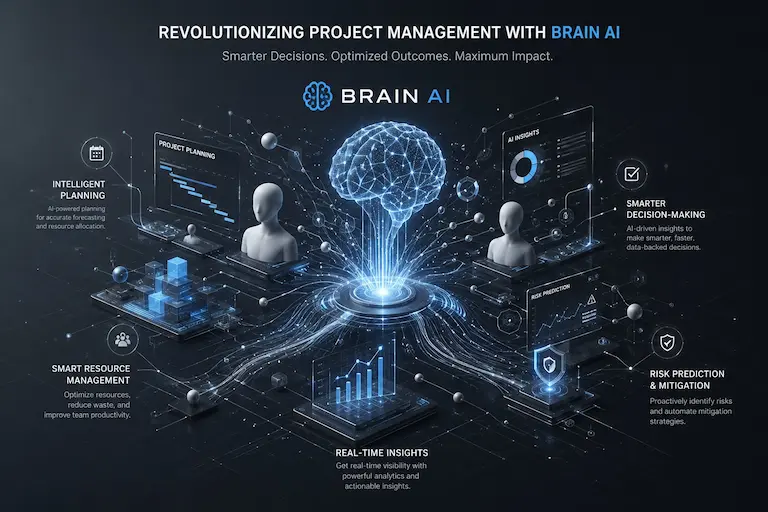
Most teams do not abandon their project management tool because it lacks features. They abandon it because using it becomes a job in itself. Someone has to update the board, chase the status, write the summary, remember who owns what. The tool was supposed to save time, and somewhere along the way it started asking for it back. That is the gap Brain AI was built to close — not by adding another panel of buttons, but by giving the platform something closer to a colleague who already knows where everything is.
Brain AI is an AI-powered assistant that lives inside the project management platform itself. You talk to it the way you would message a teammate — ask where a task stands, tell it to spin up a plan, have it pull together what changed this week — and it answers using the real data already sitting in the system. No exporting, no copy-pasting into a separate chatbot, no switching context. The intelligence sits where the work happens. 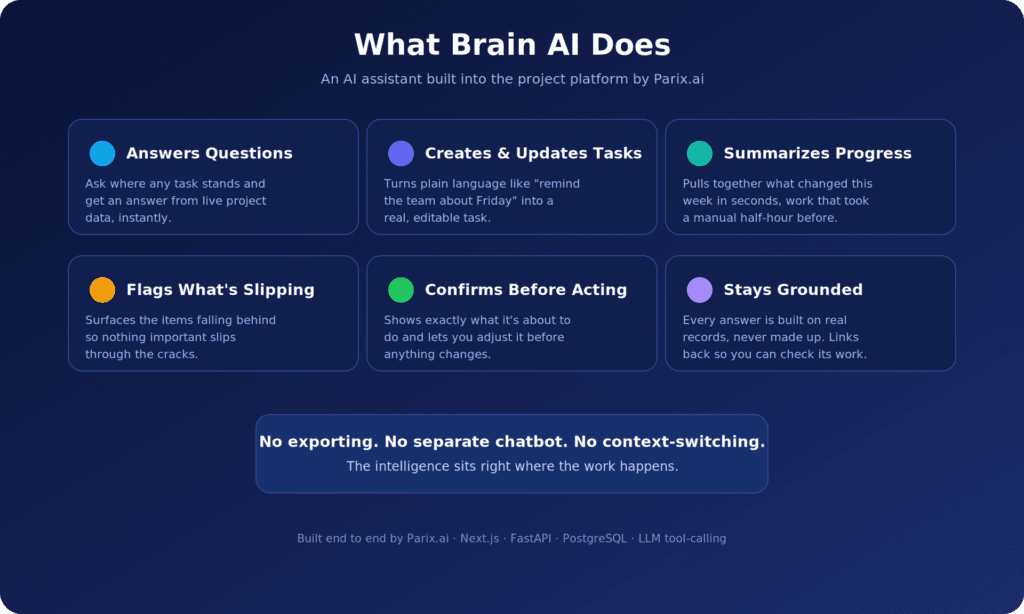
What Brain AI Set Out to Do
The brief was deceptively simple: make the platform feel like it understands you. In practice that meant three hard problems stacked on top of each other. The assistant had to hold a real conversation, not a scripted one. It had to take vague human requests and turn them into precise actions inside the product. And it had to do all of that against live project data without making things up — because an assistant that confidently invents a deadline is worse than no assistant at all.
So the goal was never “add a chatbot.” It was to build a layer of intelligent workflows that could read the state of a project, reason about it, and act on it — drafting tasks, summarizing progress, flagging what is slipping — while always staying grounded in what was actually true in the database.
Designing a Conversation People Actually Trust
The hardest part of an AI product is rarely the model. It is the moment a person types something and waits to see whether the thing understood them. Get that wrong and they never type again. So a lot of the work went into the conversational interface — how the assistant asks for clarification instead of guessing, how it shows its reasoning, how it confirms before it changes anything important.
Small decisions carried a lot of weight here. When Brain AI creates a task from a sentence like “remind the design team about the Friday handoff,” it does not silently file it away. It shows you exactly what it is about to create and lets you adjust it first. When it summarizes a week of activity, it links back to the source items so you can check its work. Trust is not a feature you bolt on at the end — it is the sum of dozens of these moments, and the interface was designed around earning it. 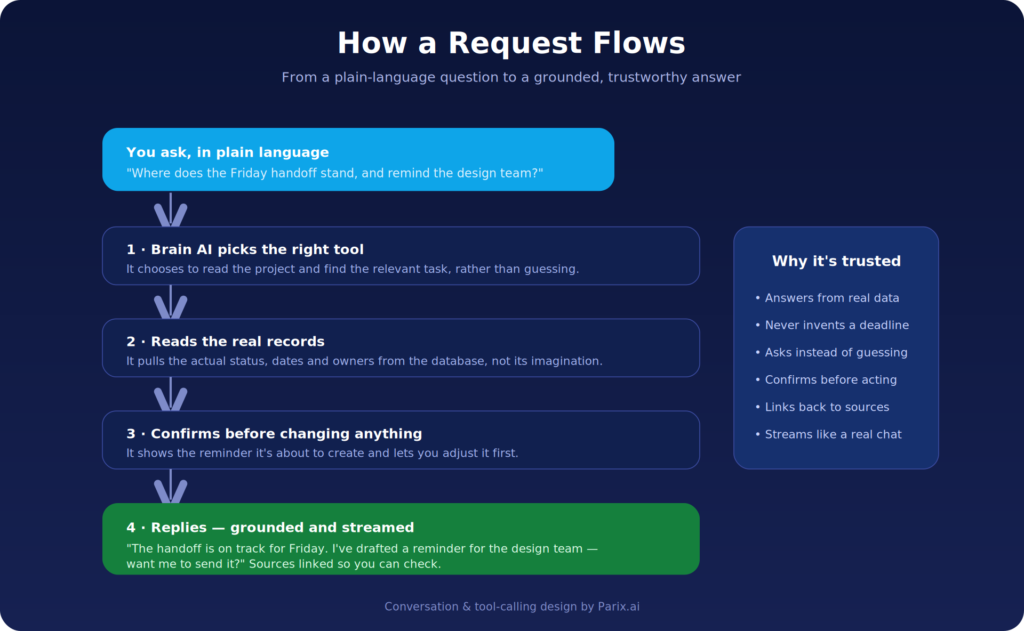
The Engine Behind the Agent
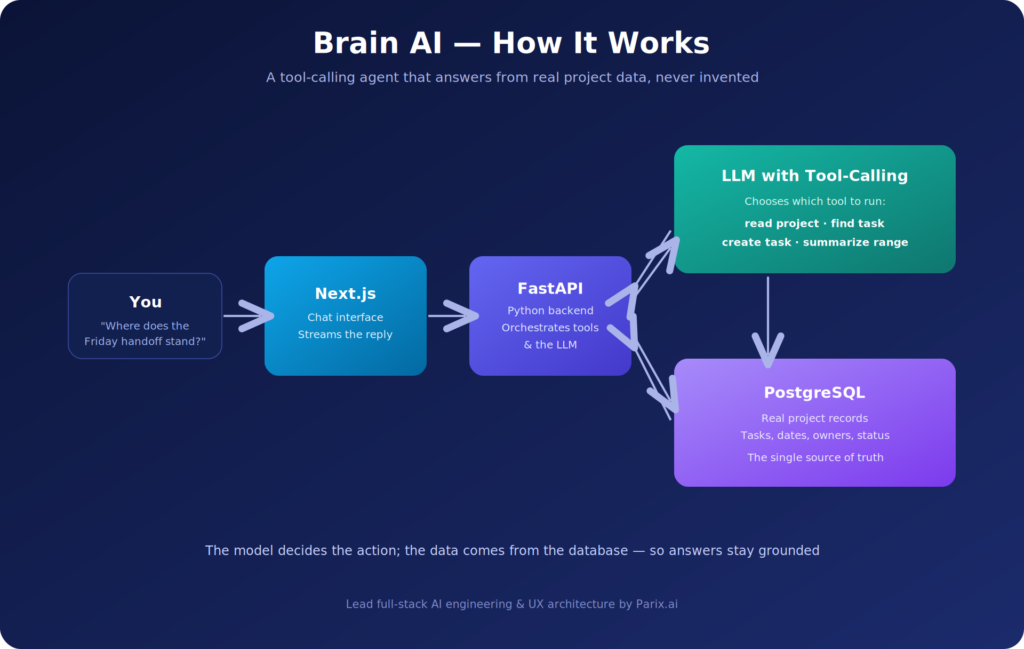
Under the hood, Brain AI runs on a Python and FastAPI backend that sits between the language model and the platform’s PostgreSQL database. The front end is built in Next.js, which keeps the chat responsive and lets the assistant’s answers stream in the way a person expects a conversation to flow — a few words at a time, not a frozen spinner followed by a wall of text.
The interesting engineering is in the middle. The assistant does not just send a prompt to an LLM and hope. It uses a set of defined tools — read a project, find a task, create one, summarize a date range — and the model decides which to call based on what you asked. The results come straight from the database, so the answer is built on real records rather than the model’s imagination. That tool-calling layer is what turns a clever chat box into something that can genuinely do the work, and it is the same kind of LLM-powered automation we build across our SaaS product development work. 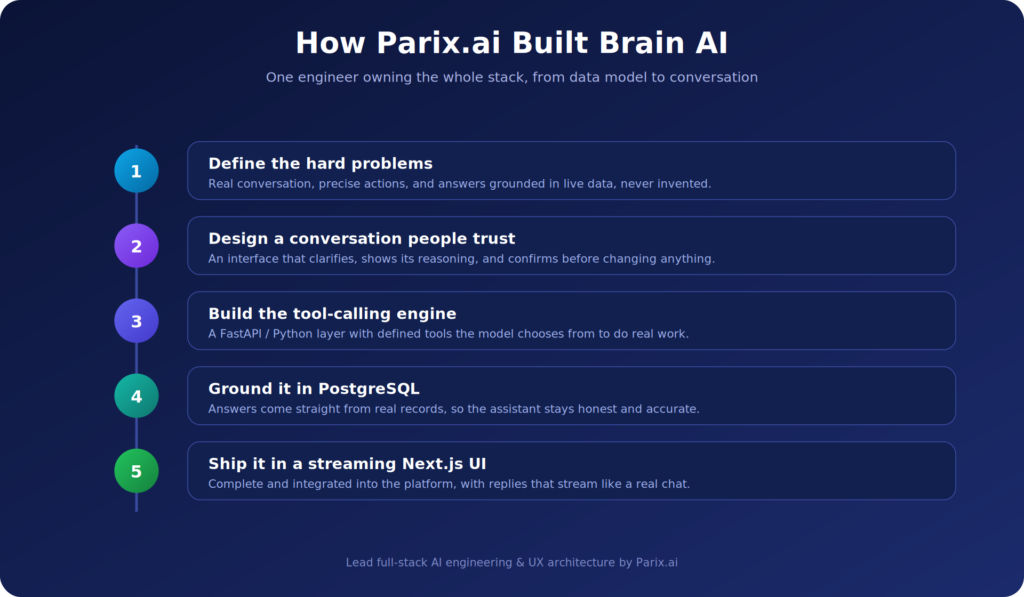
One Engineer, the Whole Stack
Brain AI was built end to end in the role of Lead Full-Stack AI Engineer and UX Architect — meaning the same hands shaped the database schema, the FastAPI services, the prompt and tool design, and the Next.js front end the user actually touches. That matters more than it sounds. When one person carries a feature from the data model all the way to the conversation, the seams disappear. The way the assistant phrases an answer is informed by how the data is stored; the way the data is stored is informed by what the conversation needs. Nothing gets lost in a handoff because there was no handoff.
This is the same full-stack approach behind Seotly, our AI-powered SEO platform — another product where a single engineer owned everything from the agents down to the deployment, and the result felt coherent because of it.
A Finished, Working Product
Brain AI is complete and integrated into the platform. It answers questions about live projects, drafts and updates tasks from plain language, and pulls together progress summaries that used to take someone a manual half-hour of clicking around. The point was never to replace the people doing the work — it was to take the administrative weight off them so they could spend their attention on the work itself instead of on feeding the tool.
Why It Matters
Anyone can wire a language model to a chat box now. The difference is in whether it can be trusted with real data, real actions, and real consequences inside a product people depend on every day. Brain AI was built to clear that higher bar — grounded in actual records, honest about what it is doing, and useful from the first message. For a business weighing up whether to trust Parix.ai with an AI build of their own, it answers the question directly: this is what a well-built AI agent looks like when it ships.
Before and After
Before
- Someone had to update the board, chase status and remember who owned what
- Pulling together a progress summary meant a manual half-hour of clicking around
- The tool that was supposed to save time had started asking for it back
After
- Questions about live projects are answered in plain language, from real records
- Tasks are drafted and updated from a sentence, with a preview before anything is created
- Progress summaries are assembled automatically, with links back to the source items so the work can be checked
The Outcome
The half-hour of clicking around that a progress summary used to take is gone. Brain AI assembles it from live project data and links back to each source item, so the summary can be verified rather than trusted blindly.
The engineering that makes it dependable sits in the middle layer. Rather than sending a prompt to a language model and hoping, the assistant calls defined tools — read a project, find a task, create one, summarise a date range — and the results come straight from the database. The answer is built on real records instead of the model’s imagination.
It confirms before it acts. Ask it to remind the design team about a Friday handoff and it shows exactly what it is about to create and lets you adjust first. That restraint is the whole product: an assistant that confidently invents a deadline is worse than no assistant at all.
The point was never to replace the people doing the work. It was to take the administrative weight off them so their attention goes to the work itself instead of to feeding the tool.
Curious what else in your own workflow is worth automating first? Our free AI Business Automation Idea Generator suggests the highest-impact tasks for your business specifically.
Ready to streamline your operations?
Parix.ai helps growing businesses identify repetitive tasks, improve workflow visibility, and build smarter systems that save time as the business scales.
Talk to Parix.ai