AI Search Optimization: How Businesses Get Found in ChatGPT, Gemini & Google AI in 2026
For years, getting found online meant one thing: ranking on Google. You picked your keywords, built your pages, chased the first page of results, and waited for the clicks. That game still matters in 2026, but it’s no longer the whole game. People have started asking AI tools their questions instead of typing keywords into a search box, and that single change is quietly rewriting the rules of online visibility.
This guide breaks down what’s actually happening, why it matters for your business, and the practical things you can do so AI search engines like ChatGPT, Gemini, Perplexity, Copilot, and Google’s AI answers actually pick your content when someone asks a question you can answer.
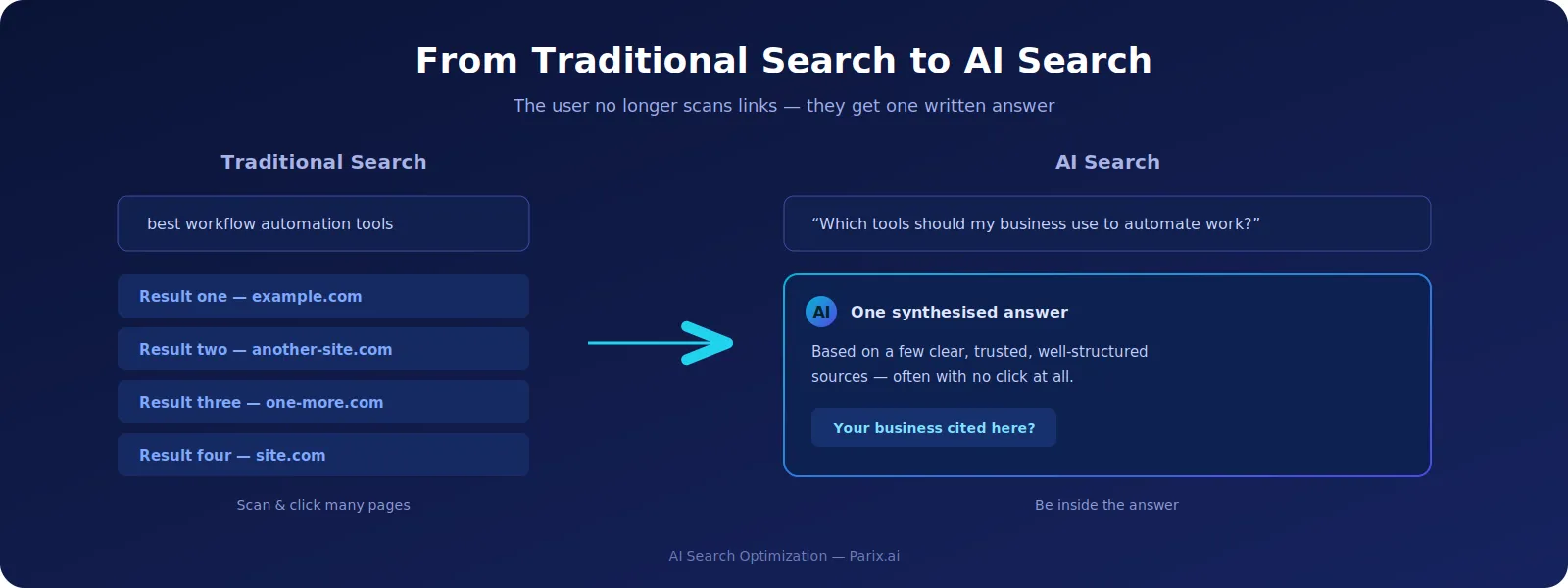
The Shift From Traditional SEO to AI Search
Here’s the difference in plain terms. In old-school search, someone types a few keywords, scans a list of links, and clicks around several websites to piece together an answer. In AI search, they ask a full question in normal language, and the AI reads across many sources and writes one answer back. The user often never sees a list of links at all, they just get the response.
That flips the goal. It’s no longer enough for your page to rank for a keyword. Your content now has to be clear enough that an AI can read it, understand it, trust it, and reuse it when forming its answer. Helping content do exactly that is what AI search optimization is really about, and it’s becoming a core part of staying visible.
The good news is that this doesn’t throw away your existing SEO work. AI search builds on top of it. Fast pages, a clean site structure, mobile-friendly design, and genuinely useful content all still matter, because the same signals that help Google rank you also help an AI decide your content is worth quoting. You’re adding a layer, not starting over.
Why AI Search Visibility Matters for Your Business
This isn’t a “someday” trend, it’s already moving real traffic. Gartner predicts that traditional search engine volume will drop 25% by 2026 as people lean on AI chatbots and virtual agents for answers. If a quarter of the old search clicks are moving somewhere new, you want your business to show up in that new place.
There’s an upside hiding in that shift, too. AI tools tend to reach people earlier in their decision, while they’re still figuring out what they need. If an AI mentions your business when someone asks “who can help me automate my order process,” you’re in the conversation before a competitor’s ad ever loads. That’s a far better position than fighting for attention at the very end.
It also changes which numbers you should watch. Fewer people may land on your site from an AI answer, but the ones who do are usually better informed and closer to buying. So instead of obsessing over raw traffic, it’s smarter to track engagement, leads, and conversions, the metrics that actually reflect business results rather than just visits.
How AI Search Engines Decide What to Show
AI systems aren’t choosing content at random, and they’re not rewarding keyword repetition the way old search sometimes did. They favour content that’s clear, well-organised, genuinely helpful, and backed by some sign that it’s trustworthy. Think of it less as gaming an algorithm and more as earning a spot, your content gets chosen because it deserves to be.
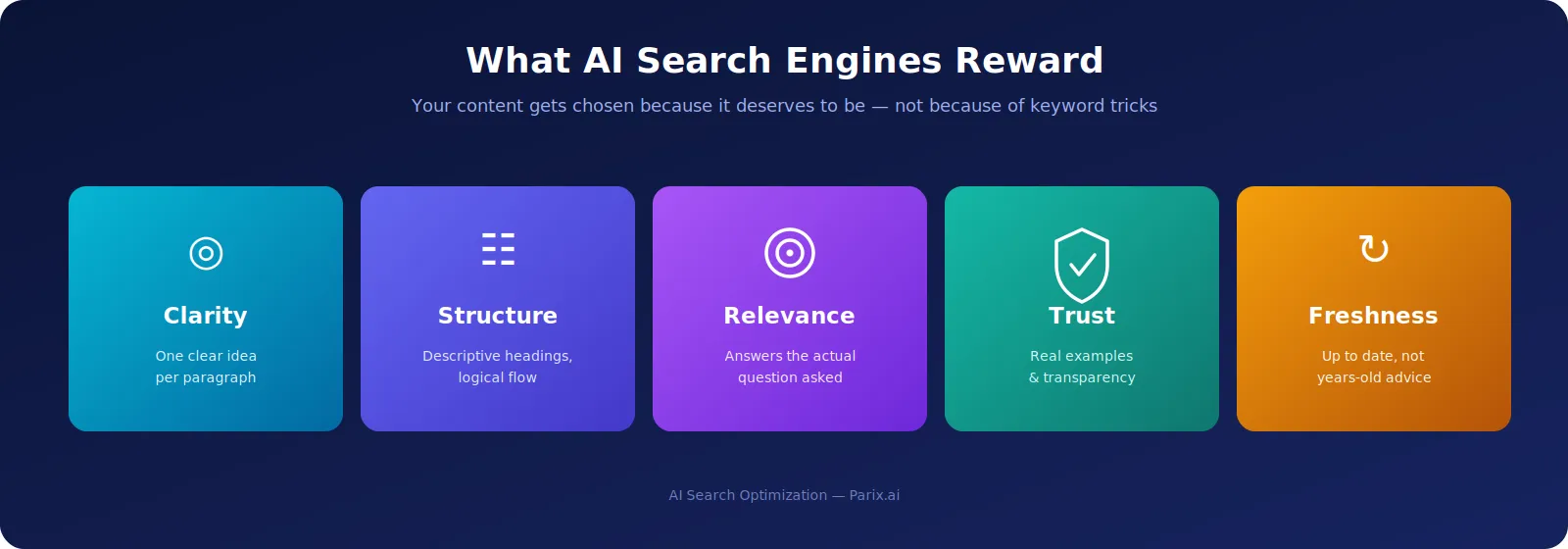
In practice, a handful of qualities make content easy for an AI to pick up and present:
- Clarity: simple language and one clear idea per paragraph, so the meaning is obvious.
- Structure: descriptive headings and logical flow the AI can follow.
- Relevance: content that directly answers the question being asked.
- Trust: real examples, evidence, and transparency about who you are.
- Freshness: up-to-date information rather than years-old advice.
How to Write Content That Wins in AI Search
Start with the question, not the keyword. Before writing a page, ask what someone is really trying to find out, how a service works, what it costs, what could go wrong, how to choose. When your content answers those questions head-on, it’s useful to a reader and easy for an AI to lift into its response. Most weak content fails here, because it was written to rank rather than to help.
Use descriptive headings that say exactly what a section covers. “What Is AI Search Optimization?” tells both a human and a machine what’s coming; a vague heading like “The New Change” tells neither. Clear headings act as signposts, and AI systems lean on them heavily to understand how your page is organised and what each part is about.
Answer the question in the first sentence, then explain. If a section asks “How does AI search optimization work?”, open with a direct answer like “It’s the practice of structuring content so AI systems can read, understand, and reuse it,” and expand from there. This front-loaded style is exactly what AI tools quote, because the answer is right where they expect to find it.
And be specific. “We deliver innovative digital solutions” says nothing; “we build automated order workflows that cut manual data entry” says something a reader and an AI can both grasp. Concrete language about what you actually do, drawn from the same craft behind solid web development, beats vague marketing every time.
The Technical Foundations You Can’t Skip
None of your content gets chosen if search systems can’t reach it. So the baseline is a site that’s crawlable and indexable, with no broken links, accidental noindex tags, or misconfigured robots files quietly hiding your pages. This is unglamorous work, but it’s the floor everything else stands on.
Structured data is one of the most direct ways to help machines understand a page. Adding the right schema, schema.org markup such as Article, FAQ, LocalBusiness, or Product types, spells out what your content actually is, as long as the markup reflects what’s genuinely visible on the page. It’s like handing the AI a labelled map instead of making it guess.
Page experience rounds it out. Even great writing underperforms on a slow site, which is why a fast, clean and user-friendly design helps both readers and AI systems. Keep your important details, features, pricing, descriptions, in plain HTML text rather than locked inside images or PDFs, because text is what these systems read most reliably.
Internal Linking, Trust, and Multimodal Search
Internal links help both people and AI understand how your topics connect. When an article on AI search links to your related work, it builds a web of meaning across your site that signals depth on a subject, much like the way our Seotly case study connects to the AI and product work behind it. A well-linked site reads as an authority, not a collection of stray pages.
Trust signals matter just as much. Clear contact details, named authors, real customer examples, and honest service descriptions all tell users and AI systems that there’s a real, credible business behind the words. Backing claims with evidence rather than adjectives is what separates content that gets cited from content that gets ignored.
Search is also getting multimodal, people now search by voice, image, and screenshot, not just text. Google’s own AI features documentation shows how these answer experiences pull from across the web, so adding proper alt text to images and clear titles to videos helps your content show up no matter how the question is asked.
How Parix.ai Helps
At Parix.ai, we treat AI search visibility as part of building a strong digital presence rather than a one-off trick. That means clean technical foundations, content structured for both people and machines, and the AI know-how to connect it all together, the same thinking behind our work on AI-powered workflow automation. The aim is simple: when someone asks an AI a question your business can answer, your business is what comes up.
If you’d rather not do all of this in-house, that’s exactly the kind of work we take on, from fixing the technical basics to producing content built to be found. You can talk to the Parix.ai team about where your site stands today and what it would take to stay visible as search keeps changing.
Conclusion
AI search isn’t replacing SEO so much as raising the bar on what good content has to do. The businesses that win in 2026 will be the ones that write clearly, structure their pages well, earn trust with real evidence, and keep their technical house in order, so that whether a customer searches on Google or asks an AI assistant, the answer points back to them. If you want help getting there, building it on solid foundations is what we do best.
FAQs
What is AI search optimization?
It’s the practice of structuring and writing your content so AI-powered search tools like ChatGPT, Gemini, Perplexity, and Google’s AI answers can understand it, trust it, and present it when users ask relevant questions. It builds on traditional SEO rather than replacing it.
Is traditional SEO still worth doing in 2026?
Yes. Strong technical SEO, fast pages, good site structure, and helpful content remain essential, because the same signals that help you rank on Google also help AI systems decide your content is worth using. AI search adds a layer on top of SEO; it doesn’t cancel it out.
How is AI search different from a normal Google search?
In a normal search, you type keywords and click through a list of links. In AI search, you ask a full question and the AI writes a single answer by reading across many sources, often without you visiting any website at all. That means your content has to be clear enough for an AI to reuse, not just rank.
How do I make my content easier for AI to choose?
Answer real questions directly, use descriptive headings, put the answer in the first sentence of each section, write in clear and specific language, add accurate structured data, keep pages fast, and back your claims with real examples. Helpful, well-organised content is what AI systems favour.
Does AI search reduce my website traffic?
It can reduce raw visits, since some users get their answer straight from the AI. But the visitors who do click through are usually better informed and more likely to convert, so it’s smarter to focus on engagement and leads than on traffic volume alone.
Want a quick read on how AI-search-ready a page already is? Our free AI Overview Optimizer checks it against the factors AI answer engines actually weigh.