All-in-One Platform — replacing a dozen disconnected tools with one
Most businesses run projects, time tracking, leave management, and marketing through a dozen separate subscriptions that don't talk to each other. We built one platform where they do — log hours against a project and it's already attached, submit a form and it feeds straight into the workflow behind it, no manual reconciliation. Production-live and still evolving.
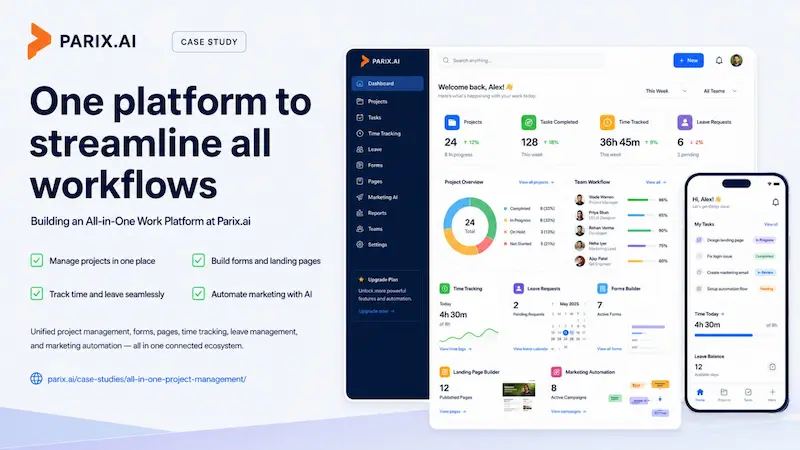
Most companies do not run on one tool. They run on a dozen. One app for tracking projects, another for logging hours, a spreadsheet for leave, a separate service for building forms, yet another for landing pages, and something else again for marketing. Each one works on its own. The trouble is the gaps between them, the copy-pasting, the data that lives in five places and agrees in none of them, the monthly bill that keeps climbing as the stack grows.
This project was built to close those gaps. It is a single project management ecosystem that pulls the pieces a team actually uses into one connected platform, from the day-to-day of running projects all the way through to building forms, publishing pages, and automating the marketing that brings work in. Parkash Kumar led the build at Parix.ai as Lead Full-Stack Product Developer and UX/UI Architect, owning both the shape of the product and the engineering that holds it up.
This is the story of what went into it, module by module, and why building one joined-up system beats stitching together a pile of separate ones.
Why One Platform Instead of Ten
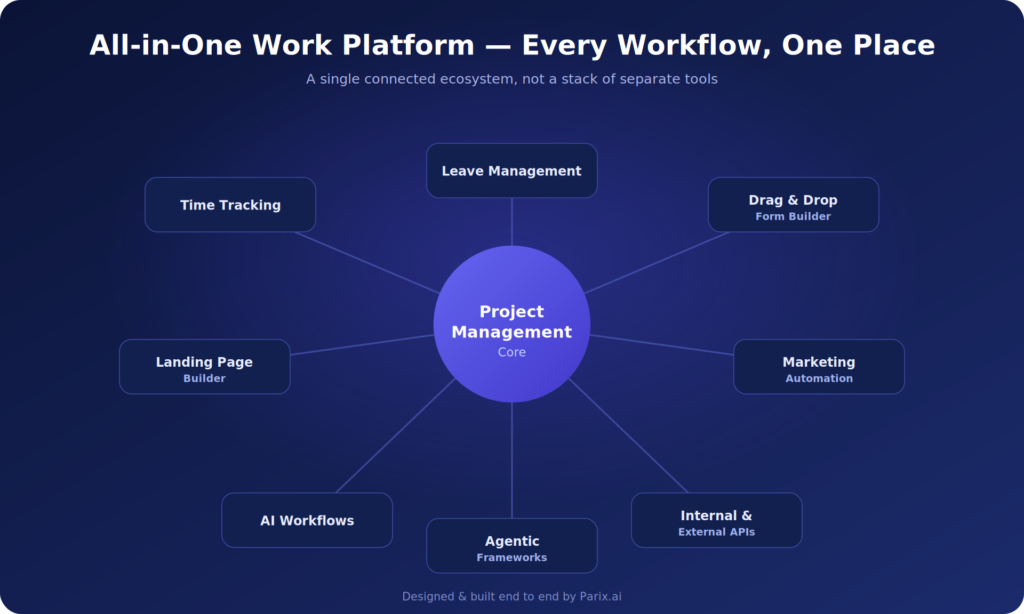
The thinking behind the platform starts with a frustration most growing teams know well. The more a business does, the more tools it accumulates, and every new tool is another login, another place for information to hide, another seam where things fall through. A task lives here, the hours against it live there, and the report that ties them together has to be assembled by hand.
An ecosystem solves this differently. When time tracking, leave, forms, pages, and marketing all live in the same system, they can talk to each other. Hours logged against a project are already attached to that project. A form someone fills in can feed straight into the workflow behind it. Nothing has to be re-entered, reconciled, or chased across apps. That was the goal from the start: not a prettier version of any one tool, but a platform where the parts are designed to work together rather than merely coexist.
Leading the Build, End to End
A product this broad is usually the work of a whole team pulling in different directions. Here, the architecture and the experience came from one lead, which is a demanding way to build but a powerful one. As lead full-stack product developer, Parkash made the calls on how the whole system fit together. As UX/UI architect, he made sure that all of that capability still felt approachable to the person using it.
Holding both roles at once matters more than it sounds. The hardest part of an all-in-one platform is not building any single module, it is keeping the whole thing coherent so it does not turn into a confusing sprawl. When one person owns both the engineering and the design language, the modules end up speaking the same visual and structural language, and the product feels like it was planned rather than assembled. It is the same end-to-end ownership Parix.ai brought to the Seotly platform and the Design Pro workspace.
The Core: A Project Management Ecosystem
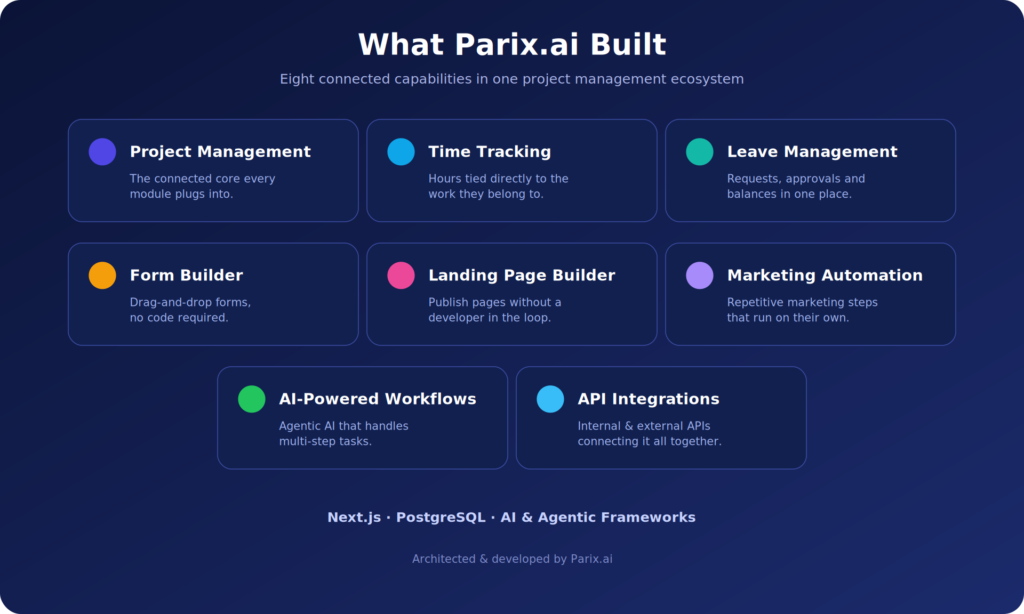
At its heart, the platform is a place to run projects, and everything else grows out of that core. It was architected as a full ecosystem rather than a single feature, which means the project management layer is not just a board of tasks but the spine that the other modules connect into. Work, people, time, and the systems around them all hang off the same structure.
Designing it as an ecosystem from day one is what makes the rest possible. It is far harder to bolt a marketing engine onto a tool that was only ever meant to track tasks than it is to build a foundation broad enough to carry all of it. That early architectural decision is the quiet reason the platform can do as much as it does without buckling.
Time Tracking
The time tracking module lets a team account for where their hours actually go. Because it lives inside the same system as the projects themselves, logged time is tied directly to the work it belongs to rather than sitting in a disconnected timesheet app. That connection is the whole point: instead of guessing how long something took or reconstructing it at month-end, the answer is already there, attached to the right project.
Leave Management
Leave is one of those things every company has to handle and almost nobody enjoys handling. The leave management module brings requests, approvals, and balances into the platform, so time off stops living in scattered emails and a separate spreadsheet. Keeping it alongside the project and time data means a team can see availability in the same place they plan their work, which is exactly where that information is useful.
The Drag-and-Drop Form Builder
This is where the platform stretches well beyond a typical project tool. The drag-and-drop form builder lets people create their own forms visually, without touching code, by placing and arranging fields directly. It is the kind of feature that sounds simple and is genuinely hard to build well, because making something flexible enough to be useful while staying easy enough for anyone to pick up is a real engineering and design challenge.
The payoff is independence. A team can spin up an intake form, a survey, or a request form whenever they need one, and because the builder lives inside the platform, what comes back through those forms can flow straight into the workflows behind them rather than landing in a disconnected inbox.
The Landing Page Builder
Alongside forms sits a landing page builder, letting the team put together and publish pages without a developer in the loop for every change. For a business that needs to launch a campaign page or a sign-up flow quickly, this removes a familiar bottleneck. The marketing idea and the page that delivers it no longer have to wait in a development queue.
Pairing a page builder with the form builder is a deliberate combination. A landing page usually needs a form on it, and here both come from the same system, so the page you build and the form you collect through it are already part of the same connected whole.
Marketing Automation
The marketing automation modules are where the platform starts working on the team’s behalf. Rather than someone manually handling every follow-up and repetitive marketing task, these modules let those steps run on their own according to rules the team sets. It is the same instinct behind Parix.ai’s workflow automation work: take the repetitive, easy-to-forget tasks and let the system carry them so people can spend their time on the parts that actually need a human.
Because this automation lives in the same ecosystem as the forms and pages, the whole chain joins up. A visitor fills in a form on a landing page, and the marketing automation can pick it up from there, all without leaving the platform or handing data between separate services.
AI Woven Through the Work
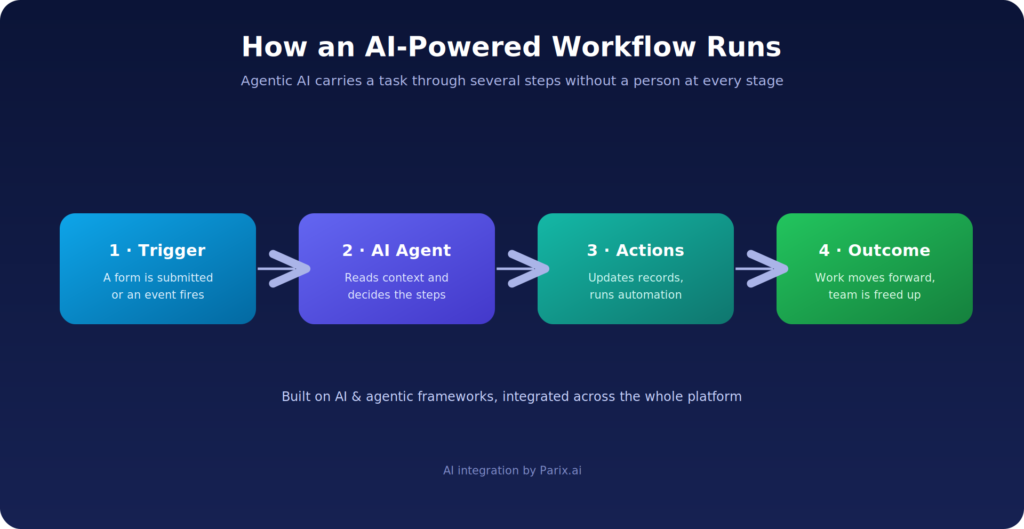
What pushes the platform past a conventional all-in-one tool is the layer of AI-powered workflows running through it. It was built with AI and agentic frameworks as part of its foundation rather than as a feature bolted on at the end. In practice, that means parts of the work the platform manages can be handled or assisted by AI rather than relying on a person for every step.
The word “agentic” is doing real work here. An agentic framework is about building AI that can carry out multi-step tasks with a degree of autonomy, not just answer a single prompt. Designing a platform around that idea is forward-looking, and it is a meaningfully harder thing to engineer than dropping a chatbot into a corner of the screen. It points the product at where software is heading, where the tool does not just hold your work but actively helps move it forward.
Connected to Everything Around It
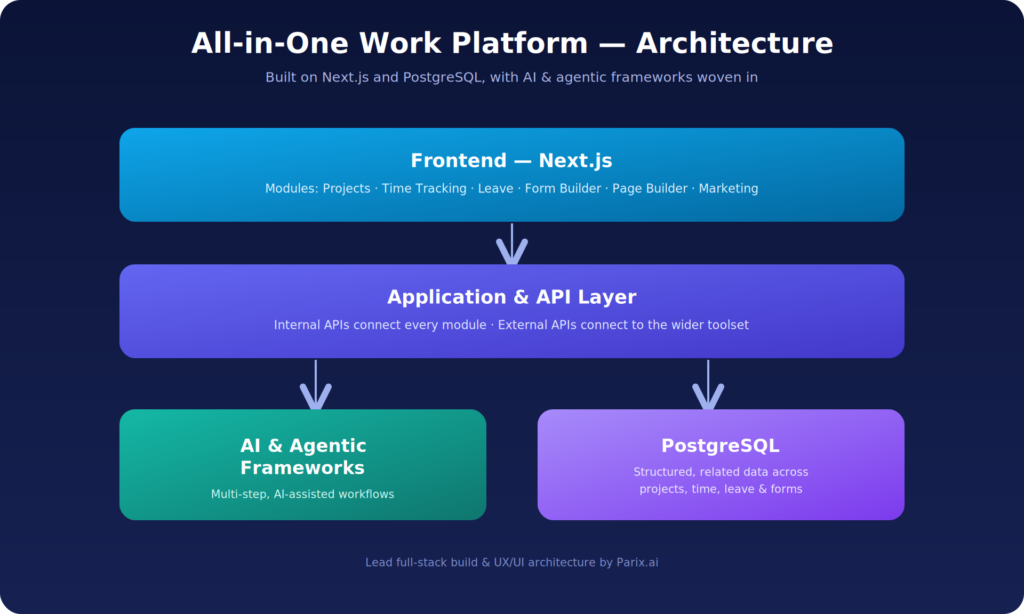
No platform is an island, and this one was built knowing that. The system integrates both internal and external APIs, which is what lets all of its own modules talk to one another and lets the platform connect out to the other services a business depends on. Internally, those connections are the wiring that makes the ecosystem behave as one product rather than a set of separate tools sharing a login.
Externally, API integration is what keeps the platform from becoming a walled garden. A business rarely wants to abandon every tool it already uses, and well-built integrations mean the platform can fit into an existing setup instead of demanding the team start from scratch. Getting this layer right is unglamorous, detailed work, and it is exactly the kind of plumbing that decides whether a platform feels like part of how a company works or a thing off to the side.
The Stack Underneath
The technology behind the platform was chosen to match its ambition. It is built on Next.js, a framework well suited to large, modern web applications that need to stay fast and maintainable as they grow. For a product with this many modules, that combination of speed and structure is not a luxury, it is what keeps the whole thing manageable. 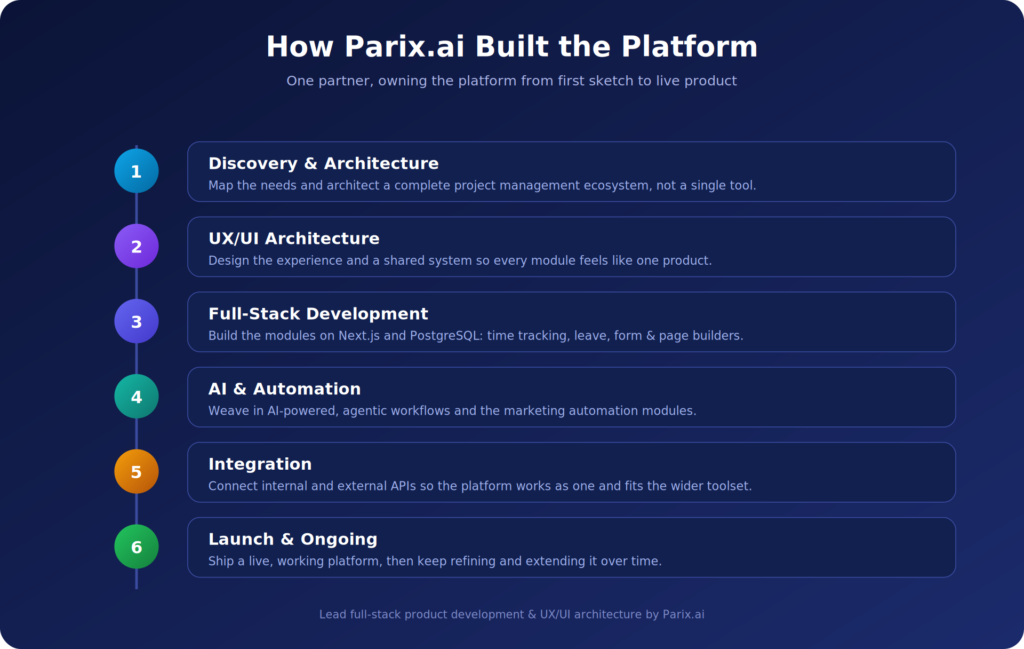
PostgreSQL anchors the data. A platform that spans projects, time, leave, forms, pages, and marketing generates a lot of structured, related information, and PostgreSQL is exceptional at exactly that, reliable, organized, and built to handle complex relationships without strain. It is a foundation you can trust as the data piles up over months and years of real use.
On top of that sit the AI and agentic frameworks that give the platform its intelligent layer. Choosing to build these in from the start, rather than treating them as an afterthought, is what lets the AI feel like a native part of the product rather than a gimmick stapled on for show.
Completed, and Still Growing
The platform is both completed and ongoing, and that pairing tells you something about how it was built. The core platform and its modules are done and in real use as a working project management system. At the same time, the work continues, with the product being refined and extended as real-world use reveals what to sharpen next.
That a platform this large can keep evolving without falling over is the clearest proof that its foundations were laid properly. A rushed, fragile build does not survive long enough to keep improving. The fact that it is still moving forward is a quiet endorsement of the architecture, the stack, and the care that went into the first version.
Why It Matters
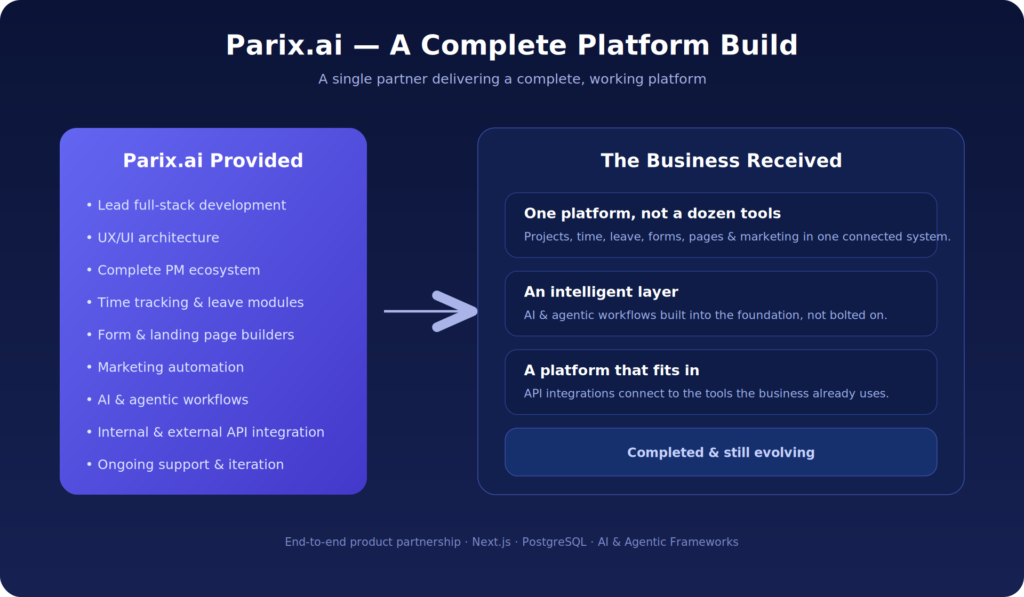
This is one of the most ambitious things on Parix.ai’s slate, and it shows what the team can take on. Building a single ecosystem that covers project management, time tracking, leave, form building, page building, and marketing automation, then threading AI through all of it, is not a small undertaking. Pulling it off with one lead owning both the architecture and the experience is rarer still.
For any business tired of duct-taping a dozen tools together, the project is a clear statement: Parix.ai can design and build a platform that does the work of many, built on solid technology and shaped by a real sense of how people actually use these systems. If that is the kind of build you have in mind, it is an easy conversation to start. Get in touch with Parix.ai here. The platform is live and still being written, and the next chapter is already underway.
Before and After
Before
- A dozen separate tools: one for projects, another for hours, a spreadsheet for leave
- A separate service for forms, another for landing pages, another again for marketing
- The same information living in five places and agreeing in none of them
- A subscription bill that climbed with every tool added
After
- Project management, time tracking and leave in one system
- A drag-and-drop form builder and a landing page builder, so a campaign no longer waits in a development queue
- Marketing automation that picks up straight from a form on a page, without leaving the platform
- AI and agentic workflows built into the foundation rather than bolted on at the end
- Internal and external API integrations, so it fits an existing setup instead of replacing everything
The Outcome
Hours logged against a project are already attached to that project. A form submission feeds straight into the workflow behind it. Nothing is re-entered, reconciled or chased between apps, which was the entire point.
The architectural decision that made this possible came first: it was designed as an ecosystem from day one, not as a task tool that grew. Bolting a marketing engine onto something built only to track tasks is far harder than laying a foundation broad enough to carry all of it — and that early call is the quiet reason the platform can do this much without buckling.
The platform is complete and in real use, and the work continues as production use shows what to sharpen next. A large system only stays healthy long enough to keep evolving when the foundations were laid properly; a fragile build does not survive long enough to keep improving.
Rolling out a platform like this across a team usually means clarifying who owns what first. Our free RACI Matrix Generator makes that explicit before anything gets built.
Ready to streamline your operations?
Parix.ai helps growing businesses identify repetitive tasks, improve workflow visibility, and build smarter systems that save time as the business scales.
Talk to Parix.ai