
Every electrical project starts with a takeoff, and almost every estimator quietly dreads it. A takeoff is the painstaking process of going through a set of electrical drawings and counting everything: every outlet, every switch, every fixture, every device and component that has to be bought and installed. Get it right and the bid is sound. Get it wrong and you have either underbid a job and lost money, or overbid it and lost the work. Either way, it is hours of careful, eye-straining counting across page after page of dense drawings.
Electrical TakeOff was built to take that burden off people. It is an AI-driven platform that processes architectural and electrical drawing PDFs and does the takeoff automatically, extracting the sheets, applying scaling and measurements, and detecting the electrical devices and components on the page using computer vision and AI. This is the story of the engineering behind it, where the contribution spanned the full stack, building both the frontend and backend, the PDF processing, the AI device detection, and the measurement and automation behind the engineering calculations.

Why the Manual Takeoff Is Such a Problem
Manual takeoffs sit at an awkward intersection of high stakes and high tedium. The work itself is repetitive counting, the kind of thing that numbs the mind after the third sheet. And yet the accuracy of that counting directly decides whether a bid wins and whether the job makes money. It is a task nobody enjoys, that everybody has to do carefully, on a deadline.
It also scales terribly. The more drawings a job involves, the longer the takeoff takes, and the more chances there are for a tired estimator to miscount a symbol or skip one entirely. That fragility is the real cost. Electrical TakeOff set out to fix both halves of the problem at once, removing the tedium and tightening the accuracy, by handing the counting to a system that does not get tired and does not lose its place on page forty.
What the Platform Does
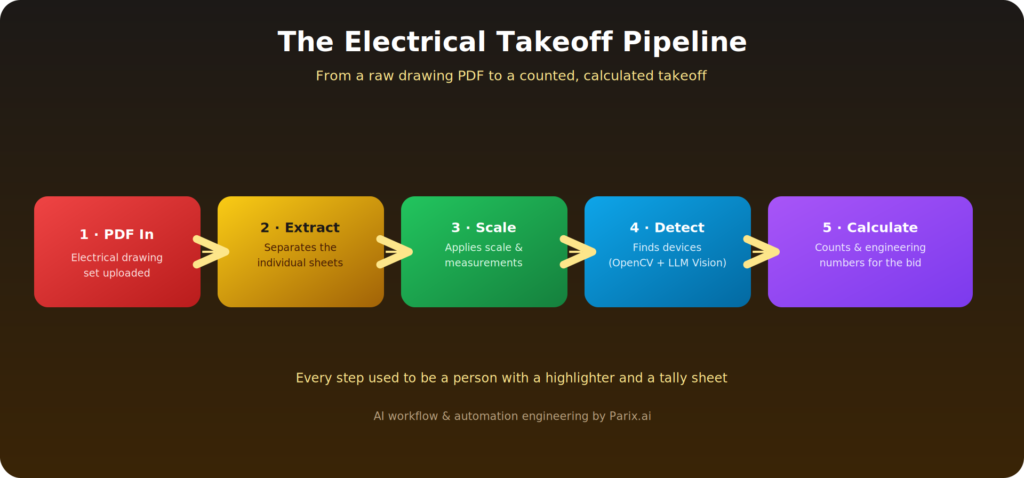
Electrical TakeOff takes a drawing PDF in and produces an automated takeoff out, and several hard steps sit in between. The platform extracts the individual sheets from a document, applies scaling so the drawing’s dimensions map to the real world, runs measurements, and detects the electrical devices and components on each sheet. From there it can support the engineering calculations that an estimate is built on.
Each of those steps replaces something a person used to do by hand. Finding and separating the sheets, figuring out the scale, measuring, and above all counting the devices, all of it folds into one automated flow. That is the leap the platform makes: from a human slowly working through drawings with a highlighter and a tally, to an AI system that reads the same drawings and produces the counts and measurements on its own.
The AI That Recognizes the Devices
The most valuable thing the platform does is recognize electrical devices and components on a drawing, and that comes from integrating AI-powered device detection. The work brings together OpenCV, a foundational computer-vision toolkit, with LLM Vision, the newer generation of vision-capable AI models that can look at an image and reason about what they are seeing.
That combination is well suited to electrical drawings specifically. Electrical plans are full of standardized symbols, but they vary between drawing sets and are surrounded by legends, notes, and other markings. A vision-capable AI model can interpret that visual language in a way older, rigid approaches struggle with, making sense of the symbols in context rather than just matching shapes. Pairing it with classic computer vision and wiring the result into a working automated workflow is what turns it into a tool that reliably does the count, not just a clever demo.
From Drawings to Engineering Numbers
Detecting devices is the headline, but a takeoff is only useful if it produces real, trustworthy numbers, and that is where the measurement and automation modules come in. A big part of the work was building those modules for the engineering calculations, the layer that turns detected devices and scaled measurements into the figures an estimate actually depends on.
This rests on getting the fundamentals right first. The PDF has to be processed cleanly, the scaling has to be correct, and only then do the measurements and calculations mean anything. Handling the PDF extraction and processing workflows reliably across different drawing sets, applying scaling accurately, and automating the calculations on top is a demanding chain of work, and it is exactly what separates a tool that looks impressive from one an estimator can actually trust with a bid.
Built Across the Whole Stack
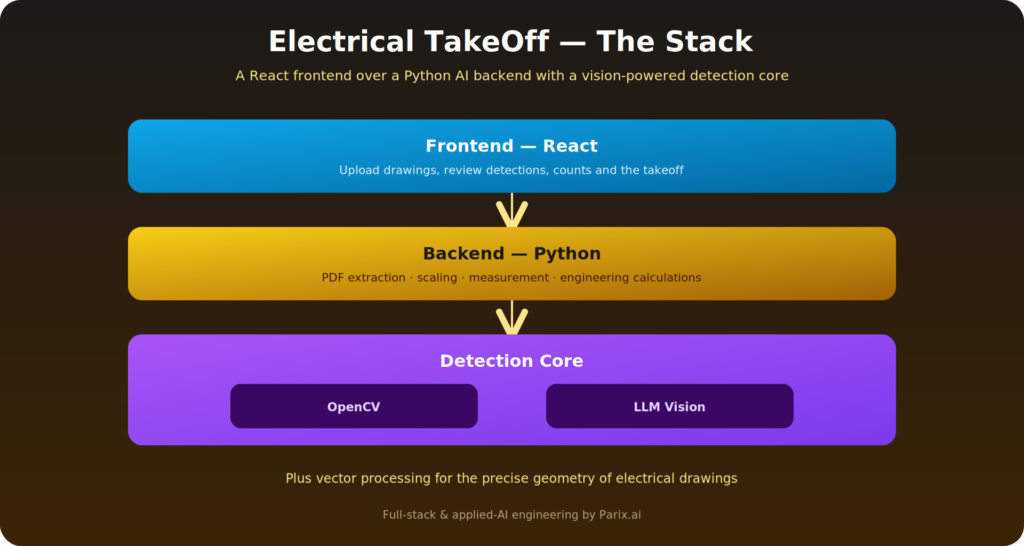
A platform like this lives in two worlds, the AI-heavy backend and the interface a person actually uses, and the work here reached across both. On the backend, that meant the Python services handling PDF processing, detection, and calculation. On the front, it meant the React features where an estimator uploads a drawing and sees the takeoff come back.
Spanning both sides is what keeps an AI product coherent. The backend can do something genuinely sophisticated, but it only matters if the interface presents it clearly enough that a busy estimator can act on it. Building both the engine and the experience meant the platform’s intelligence reached the user as something simple and usable, rather than getting stranded behind a confusing screen. It is the same full-stack, applied-AI approach behind our sister project Arcurie, which tackles measurement on architectural drawings, and our work on Brain AI.
The Stack Underneath
The technology was chosen to fit the problem. Python powers the backend, which is the natural home of computer vision and AI work and the obvious choice for the detection and calculation engine. OpenCV handles core vision tasks, LLM Vision provides the modern, context-aware device recognition, and vector processing helps deal with the precise geometry that electrical and architectural drawings are built from.
On the front end, React gives the platform a responsive, modern interface for uploading drawings and reviewing the takeoff. It is a sensible division of labor, a powerful AI backend doing the analysis and a clean React frontend making it usable, and it mirrors the same full-stack engineering and applied AI behind the rest of our product work.
What Changes for the Estimator
It helps to picture the difference on a real working day. Before a tool like this, an estimator opens a drawing set and starts the grind: zoom in, find the symbols, tally each device type, note it down, move to the next sheet, and try not to lose count or miss a corner of the page. On a large job that is a full day or more of concentration, and the pressure of a looming bid deadline only makes mistakes more likely.
With Electrical TakeOff, that same drawing set goes into the platform and comes back with the sheets separated, the scale applied, and the devices detected and counted. The estimator’s job shifts from doing the count to reviewing it, checking the system’s work and applying their judgment, rather than spending their expertise on mechanical tallying. The skill that actually matters, knowing how to price and plan a job, is freed from the busywork that used to bury it.
That shift is the whole point. The platform is not trying to replace the estimator’s judgment, it is trying to remove the tedious part that stands between them and using it. The same job takes a fraction of the time, and the count it starts from is more consistent than a hand tally ever could be.
Why It Matters
Electrical TakeOff aims squarely at a real, expensive industry problem rather than a flashy one. Manual takeoffs cost estimating teams enormous amounts of time and carry real financial risk when they go wrong. Automating that, reliably and accurately, is the kind of AI application that pays for itself, because it gives skilled people their hours back and makes the numbers more dependable at the same time.
It also sits at the genuinely hard end of AI work. Applying computer vision and vision-capable models to specialized technical drawings, and producing engineering calculations you can stake a bid on, is far harder than wiring a model to a chat box. For any business buried in technical documents and manual counting, the platform is a clear signal of what modern AI can take off their plate. If that sounds like your world, it is an easy conversation to start. Get in touch with Parix.ai here.
Before and After
Before
- An estimator counted every outlet, switch, fixture and device by hand, page after page
- On a large job that was a full day or more of concentrated counting
- A miscounted or skipped symbol meant underbidding and losing money, or overbidding and losing the work
- It scaled badly: more drawings meant more hours and more chances to lose count on page forty
After
- Drawing PDFs are processed automatically: sheets extracted, scale applied, devices detected and counted
- The estimator reviews the count instead of producing it
- The starting count is consistent across a drawing set in a way a hand tally cannot be
- Adding more drawings no longer multiplies the hours
The Outcome
The estimator’s job changed shape. It went from producing the count to checking it. Their expertise moved off mechanical tallying and onto the part that actually decides whether a bid wins: knowing how to price and plan the job.
The platform is not trying to replace that judgment. It removes the tedious work standing between the estimator and using it, and it starts from a count that does not get tired and does not lose its place.
The technically hard part was device recognition on specialised drawings. Electrical plans use standardised symbols, but they vary between drawing sets and sit surrounded by legends, notes and markings. Combining OpenCV with vision-capable AI models reads that context in a way rigid shape-matching cannot — which is the difference between a tool an estimator will stake a bid on and a clever demo.
Ready to streamline your operations?
Parix.ai helps growing businesses identify repetitive tasks, improve workflow visibility, and build smarter systems that save time as the business scales.
Talk to Parix.ai