AI Automation Audit: 30 Questions to Ask Before You Automate Your Business
An AI automation audit is a structured check you run before automating anything — a set of honest questions about your processes, data, team, costs, risks, and strategy. It helps you spot which tasks are actually worth automating and which will waste your time and money. Run this 30-question audit first and you’ll either move forward with confidence or dodge an expensive mistake.
Most businesses approach automation backwards. They get excited by a tool, automate the first thing that comes to mind, and then spend the next month wondering why the workflow keeps breaking — or why the team quietly went back to doing everything by hand. The problem is almost never the tool. The problem is skipping the thinking.
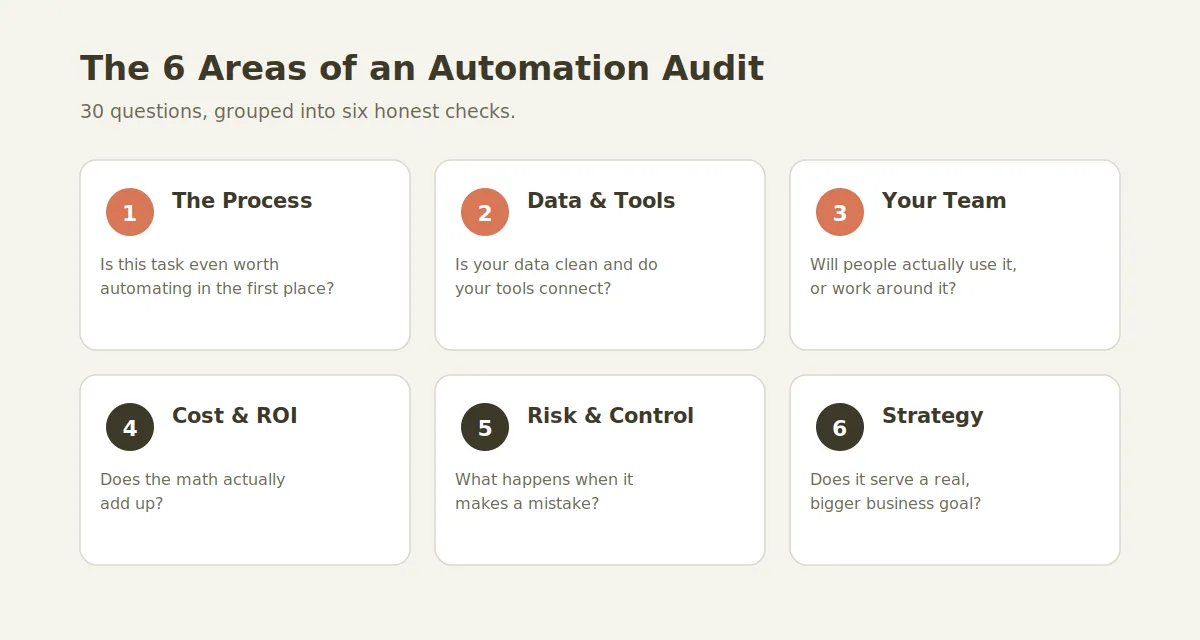
This audit is the thinking part. Thirty questions, grouped into six areas, that force an honest look at your business before you automate a single thing. You don’t need a perfect score — you need clarity about what’s worth automating, what isn’t, and what you should fix first.
Want this done for your business — no guesswork? Parix.ai audits your workflows and hands you a prioritized list of exactly what to automate first. Book a free automation consultation →
Table of Contents
- Why Run an Automation Audit First
- Part 1: Is the Process Worth Automating?
- Part 2: Are Your Data and Tools Ready?
- Part 3: Will Your Team Actually Use It?
- Part 4: Do the Cost and ROI Add Up?
- Part 5: Risk, Errors, and Control
- Part 6: Strategy and the Bigger Picture
- What Your Answers Are Telling You
- Frequently Asked Questions
- Conclusion
Why Run an Automation Audit First
Automation works — when it’s pointed at the right thing. The numbers back this up: McKinsey found that around 60% of employees could save roughly 30% of their time by automating routine tasks, and Forrester’s research shows over half of businesses reach full ROI on workflow automation within twelve months.
But those wins go to the businesses that automate deliberately. The ones that skip the audit and automate everything at once tend to create more problems than they solve. A quick, honest audit is the difference between automation that pays for itself in months and automation that becomes an expensive headache.
The audit splits into six simple areas. Here’s the map before we dig in.
Part 1: Is the Process Worth Automating?
Not everything should be automated. First, figure out whether the task in front of you is even a good candidate.
- Is this task genuinely repetitive — done the same way over and over?
- How often does it happen — daily, weekly, or rarely? Frequency is where the payoff hides.
- How much human time does it eat right now? Put a real number on it.
- Are the rules clear and consistent, or does it need fresh judgment every time?
- Should this task even exist, or is it busywork you could simply delete?
A task that’s frequent, time-consuming, rule-based, and genuinely useful is a gold-standard candidate. One that’s rare or fuzzy will cost more than it saves.
Part 2: Are Your Data and Tools Ready?
Automation connects your systems. If your data is a mess, automation just moves the mess around faster.
- Where does your data actually live — CRM, spreadsheets, inboxes, all of the above?
- Is your data clean and consistent? Duplicates and half-filled fields break workflows.
- Do your tools offer APIs or integrations? Modern tools usually connect; older ones may not.
- Are your tools talking to each other, or sitting in silos? Connecting them is what AI integrations are for.
- Who owns and maintains your data so it doesn’t drift out of date?
Clean, accessible, connected data is the foundation. Rush this and everything you build on top wobbles.
Not sure if your data is automation-ready? We’ll review your stack and tell you what needs fixing first. Get a free workflow review →
Part 3: Will Your Team Actually Use It?
The best workflow in the world is useless if your team ignores it. This is where most automation projects quietly die.
- Who will actually use this day to day? Build for them, not for yourself.
- Have you asked them what slows them down? They know the real bottlenecks.
- Will this make their jobs easier, or feel like surveillance?
- Who fixes it when something breaks? Every automation needs an owner.
- Is your team open to change, or change-resistant? Plan to bring people along.
Automation is a people problem as much as a tech one. Involve your team early and they’ll protect the system instead of routing around it.
Part 4: Do the Cost and ROI Add Up?
Automation is an investment, and the math has to make sense. Here’s what that looks like in practice for a single person:
| Metric | Before | After | Savings |
|---|---|---|---|
| Weekly hours on routine tasks | 10 | 2 | 8 hrs |
| Monthly time recovered | 40 | 8 | 32 hrs |
| Annual hours freed up | ~480 | ~96 | ~384 hrs |
That’s nearly 384 hours a year recovered from one person — and that’s before you multiply it across a team. Run these five questions against your own situation:
- What does this process cost you right now in hours and salaries?
- What will the automation cost to build, run, and maintain?
- How long until it pays for itself? (Often a few months — see our breakdown of how much AI automation actually costs.)
- What’s the cost of not automating — slow growth, burnt-out staff, lost customers?
- Are you clear why you’re automating — to save time, cut costs, reduce errors, or grow?
If you can’t roughly estimate the return, you’re not ready to spend the money yet.
Part 5: Risk, Errors, and Control
Automation runs fast — which means mistakes happen fast too. You need guardrails before you switch it on.
- What happens when it makes a mistake? A wrong email is fine; a wrong invoice isn’t.
- Is there a human checkpoint for high-stakes steps like money or contracts?
- Can you tell whether it’s working, or could it fail silently for weeks?
- Is sensitive data handled securely?
- What’s your backup plan if a tool goes down or changes its rules?
Done right, automation reduces risk. Plan for the day it misbehaves — because that day comes. (These are exactly the traps we covered in 7 AI automation mistakes that break projects after launch.)
Part 6: Strategy and the Bigger Picture
Finally, zoom out. A single workflow should serve a larger goal, not just scratch an itch.
- Does this support a real business goal, or is it automation for its own sake?
- Is this the highest-impact thing you could automate first? Start where the pain is biggest.
- Will this still make sense as you grow?
- Can it scale, or will it break when volume doubles?
- Should you build this in-house, or bring in help? Be honest about your time and skills.
When your automation ladders up to a clear goal, targets your biggest pain point, and can grow with you, you’re not just automating tasks — you’re building a smarter business.
What Your Answers Are Telling You
You don’t need thirty perfect answers — you need an honest picture of where you stand.
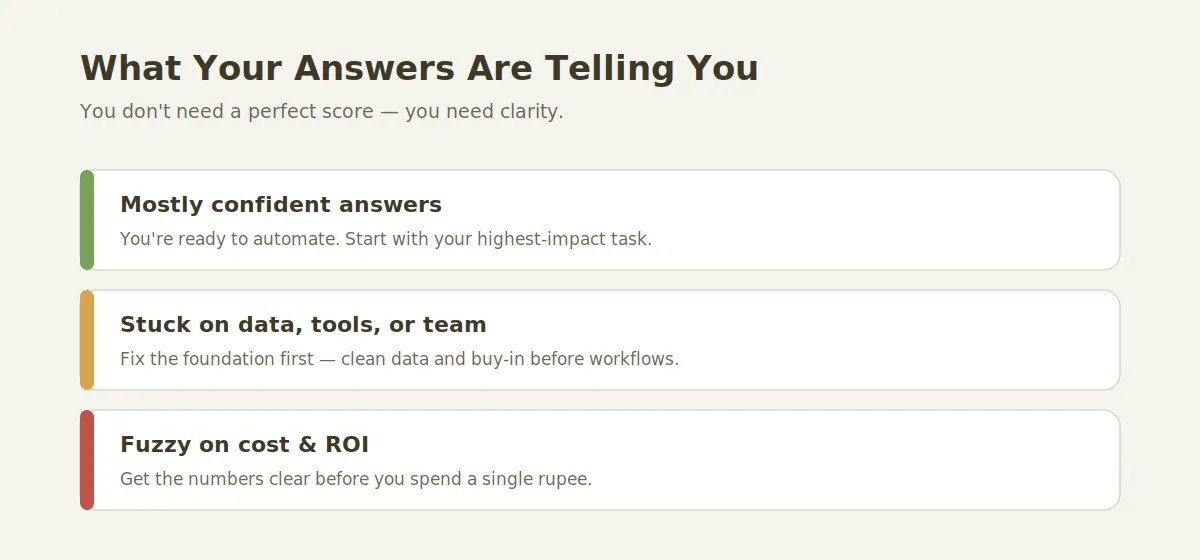
If you moved through most questions confidently, you’re ready, and you probably already sense where to start. If you stumbled in Part 2, fix your data and tools first. If Part 3 felt shaky, slow down and bring your people in. And if Part 4’s cost questions felt fuzzy, get the numbers straight before spending a rupee.
We’ve seen the upside firsthand — when we automated the operations of an ecommerce business, clearing the repetitive admin freed the team to focus on real growth. The difference between that result and an expensive flop almost always comes down to the questions you ask before you start.
Worked through the 30 questions and still unsure where to start? That’s exactly what we do. See how our automation service works →
Frequently Asked Questions
What is an AI automation audit?
It’s a structured review you run before automating, covering your processes, data, team, costs, risks, and strategy. The goal is to identify which tasks are genuinely worth automating and to surface problems — like messy data or an unclear ROI — before they derail the project.
Why should I audit before automating?
Because automating the wrong thing is expensive. An audit helps you avoid fragile workflows, wasted spend, and tools your team won’t use. Businesses that automate deliberately see far better returns than those that try to automate everything at once.
What should I automate first?
Start with the task that is most repetitive, eats the most hours, and follows clear rules. That combination gives the fastest, most visible return — and an early win builds momentum for bigger projects.
How do I know if a process is worth automating?
If it’s frequent, time-consuming, and rule-based, it’s almost always worth it. If it’s rare or needs fresh human judgment every time, automating it usually costs more than it saves.
How much time can automation actually save?
Research from McKinsey suggests around 60% of employees could save roughly 30% of their time by automating routine work. In practice, automating a focused set of repetitive tasks often recovers several hundred hours per person per year.
How long until automation pays for itself?
Forrester found over half of businesses reach full ROI within twelve months, and simple, high-frequency automations often pay back faster. The cleaner the task and the more time it removes, the quicker the return.
Do I need technical skills to automate my business?
Not always. Many high-impact automations can be built with no-code tools like Zapier, Make, or n8n. For more complex or custom needs — like AI agents that handle multi-step work — a specialist usually saves far more time than they cost.
What should I never fully automate?
Avoid putting high-stakes, judgment-heavy work on full autopilot — sensitive customer conversations, legal or financial decisions, anything where a mistake is costly. Keep a human checkpoint on those.
Conclusion
An AI automation audit isn’t about slowing you down — it’s about making sure your automation actually works. Instead of guessing and hoping, you run thirty honest questions across six areas and come out knowing exactly what to automate, what to fix first, and what to leave alone.
Start by working through the questions above. Be honest about your data, your team, and your numbers. Pick the highest-impact, lowest-risk task, automate it carefully with a human checkpoint where it matters, prove the value, then expand.
Want a faster first pass before booking a call? Run our free Automation Readiness Quiz for an instant, no-signup gut check.
If you’d rather not run the audit alone, that’s exactly what we do at Parix.ai — we map your workflows, pinpoint the highest-impact tasks, and build the automations using tools like Zapier, Make, n8n, and custom AI agents. You can browse our case studies to see the results we’ve delivered, or get in touch for an honest conversation about whether automation is worth it for your business.