Which Claude Model Should You Use? Opus 5 vs Sonnet 5 vs Fable 5 vs Haiku 4.5
Update (October 2026): Anthropic has since released Claude Fable 5.1, Opus 5.5, Sonnet 5.5 and Haiku 5.5, and now lists Fable 5, Opus 5, Sonnet 5 and Haiku 4.5 as legacy models (still available). Its current advice is to start with Opus 5.5 for most workloads and use Fable 5.1 for demanding reasoning and long-horizon agentic work. Current prices per million input/output tokens: Fable 5.1 $10/$50, Opus 5.5 $4/$20, Sonnet 5.5 $2/$10, Haiku 5.5 from $0.10/$0.50. The comparison below covers the earlier generation; see Anthropic’s models overview for the latest line-up.
Short answer: Start with Sonnet 5 for everyday work. Move up to Opus 5 when the task is ambiguous or expensive to get wrong. Use Haiku 4.5 for high-volume, simple jobs, and Fable 5 only for long-running autonomous work where failure costs more than the tokens. Most teams pick one model for everything and overpay.
That is the whole decision in four sentences. The rest of this guide shows you the numbers behind it, where each model actually wins, and the API differences that catch people out after they have already committed.
If you connect any of these models to your own systems through MCP, the failure modes are different again — a server can look connected while its tools never load. Our MCP server checklist covers what to get right before you connect anything.
The four models at a glance
Anthropic shipped three new models in under two months in 2026: Fable 5 on 9 June, Sonnet 5 on 30 June, and Opus 5 on 24 July. Haiku 4.5 carried over from the previous generation. There is also Mythos 5, but you almost certainly cannot use it — more on that below.
| Model | Price (in / out per M tokens) | Context | Max output | Knowledge cutoff | API ID |
|---|---|---|---|---|---|
| Fable 5 | $10 / $50 | 1M | 128K | Jan 2026 | claude-fable-5 |
| Opus 5 | $5 / $25 | 1M | 128K | May 2026 | claude-opus-5 |
| Sonnet 5 | $2 / $10 | 1M | 128K | Jan 2026 | claude-sonnet-5 |
| Haiku 4.5 | $1 / $5 | 200K | 64K | Feb 2025 | claude-haiku-4-5-20251001 |
Source: Anthropic’s official models overview and pricing documentation, checked 31 August 2026. Providers change rates — verify before budgeting.
Three details most comparisons get wrong.
Haiku 4.5 does not have a 1M context window. It has 200K, and a 64K output ceiling. If you are feeding long documents, Haiku is out regardless of how cheap it is.
Opus 5 knows more recent history than Fable 5. Opus 5 has a May 2026 knowledge cutoff. Fable 5 and Sonnet 5 both stop at January 2026 — so the most expensive model in the lineup knows less about recent events than the mid-tier one.
Haiku 4.5 is the only model with a near-term retirement date. Anthropic commits to keeping it available until no sooner than 15 October 2026. Opus 5 runs to at least July 2027, Sonnet 5 to June 2027, Fable 5 to June 2027. If you have built anything on Haiku 4.5, you need a migration plan this quarter — and almost nobody writing these comparisons mentions it.
Which Claude model should I use?
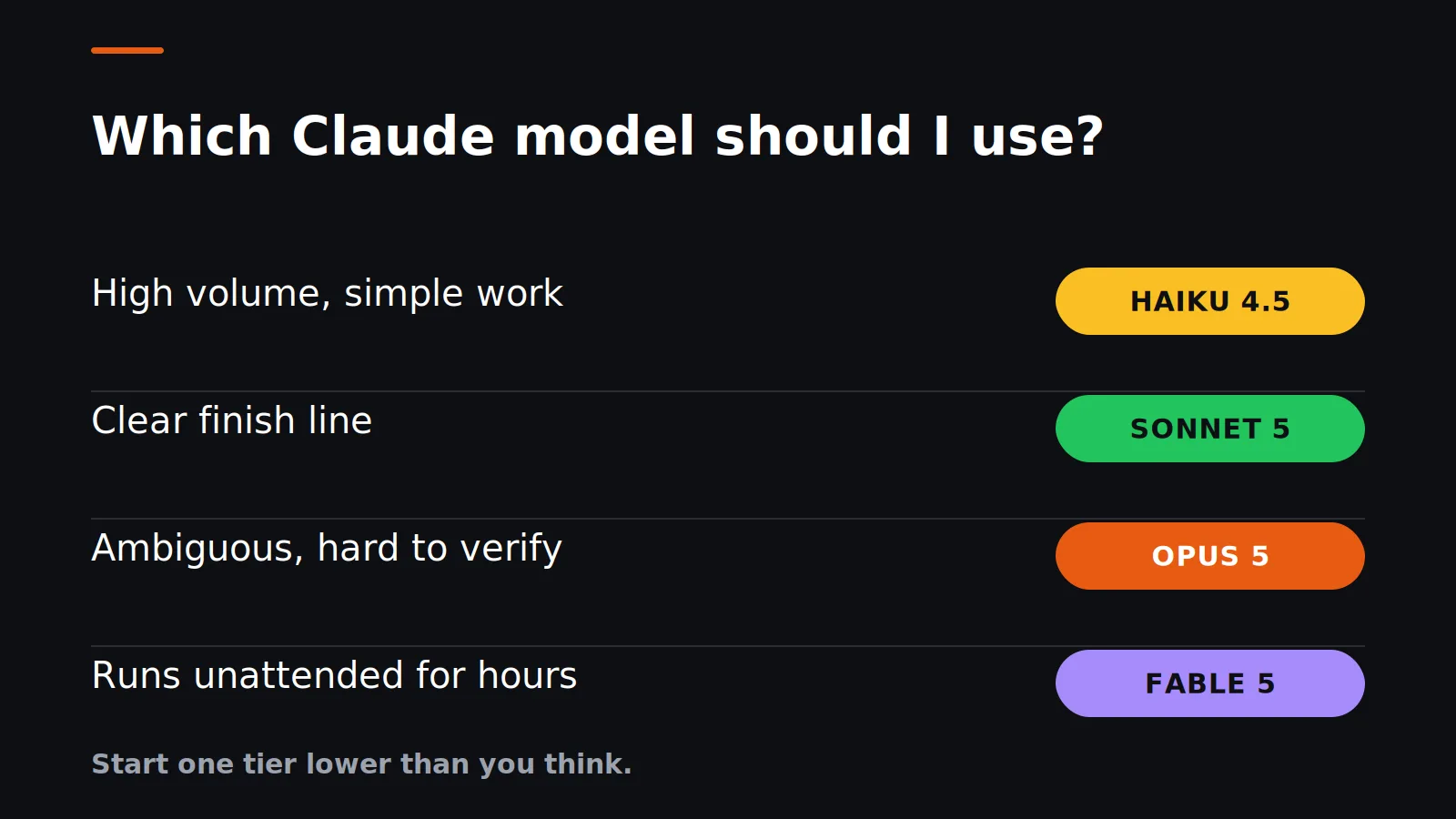
Answer: Match the model to the task, not the task to one model. Use Haiku 4.5 for high-volume simple work, Sonnet 5 as your everyday default, Opus 5 when the task is ambiguous or costly to redo, and Fable 5 for long-horizon autonomous runs.
Anthropic’s own guidance is to start with Opus 5 for complex agentic coding and enterprise work, and use Fable 5 when you need the highest available capability. In practice, most businesses find Sonnet 5 handles more than they expected, which is why we recommend starting a tier lower and escalating only when a task actually fails.
Here is the decision in order:
- Is the job high-volume and simple? Classification, extraction, routing, tagging. → Haiku 4.5
- Is the finish line clear? Scoped features, known bugs, recurring reports, structured summaries. → Sonnet 5
- Is the job ambiguous? Root-cause debugging, architecture decisions, conflicting evidence, hidden constraints. → Opus 5
- Will it run unattended for a long time? Open-ended autonomous work where a failure is expensive to unwind. → Fable 5
Claude Opus 5 vs Sonnet 5
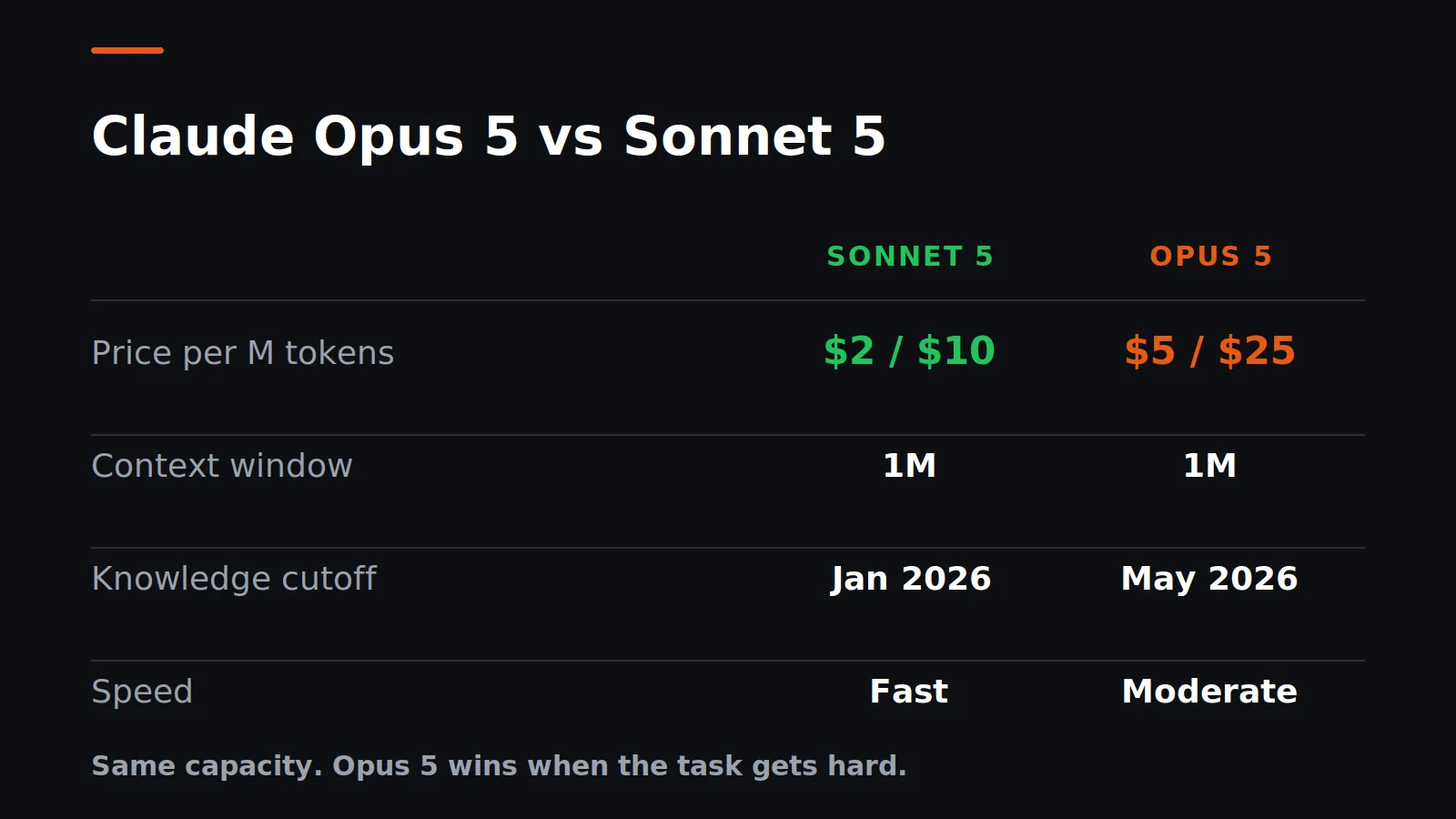
Answer: Opus 5 costs $5/$25 per million tokens, Sonnet 5 costs $2/$10. Both share a 1M context window and 128K max output. The difference is not capacity — it is how each behaves when a task gets difficult.
| Factor | Sonnet 5 | Opus 5 |
|---|---|---|
| Price (in / out) | $2 / $10 | $5 / $25 |
| Latency | Fast | Moderate |
| Context / max output | 1M / 128K | 1M / 128K |
| Knowledge cutoff | Jan 2026 | May 2026 |
| Thinking | Adaptive | Adaptive |
| Best at | Throughput and cost | Reasoning and self-verification |
Sonnet 5 is the better default when the finish line is clear. Give it a feature with acceptance criteria, a reproducible bug, or a report template, and it delivers at a fraction of the cost. That advantage compounds across repeated runs.
Opus 5 earns its price when instructions are incomplete or the task changes halfway through. It is more likely to inspect its own output, notice a weak assumption, and keep working until the result holds together. One successful expensive run often costs less than a cheap attempt plus two retries plus a human cleanup.
The practical test: if a task has already failed twice on Sonnet 5, that is your signal to try Opus 5 — not to write a longer prompt.
Claude Opus 5 vs Fable 5
Answer: Opus 5 is exactly half the price of Fable 5 — $5/$25 against $10/$50 — and matches or beats it on several of Anthropic’s own published evaluations. For most business work, Opus 5 is the better default.
nThis flips the usual assumption that the pricier model always wins, and Anthropic’s published figures say so directly:
- CursorBench 3.2 — at maximum effort, Opus 5 performs within 0.5% of Fable 5’s peak score, at half the cost per task.
- OSWorld 2.0 — Opus 5 surpasses Fable 5’s best result at just over a third of the cost.
- Frontier-Bench v0.1 — Opus 5 more than doubles Opus 4.8’s performance, at a lower cost per task.
- ARC-AGI 3 — Opus 5 scores three times as high as the next-best model.
Figures as published in Anthropic’s Claude Opus 5 announcement. These are vendor-reported results — useful for direction, not a substitute for testing on your own workload.
Where Fable 5 still leads is the longest, most open-ended autonomous work. It also has adaptive thinking permanently on, which suits jobs that run for hours without supervision.
One compliance detail worth knowing: Fable 5 is not available under zero data retention — it requires 30-day retention. If you work with regulated clients, that single line may decide the question before price does.
What is the cheapest Claude model?
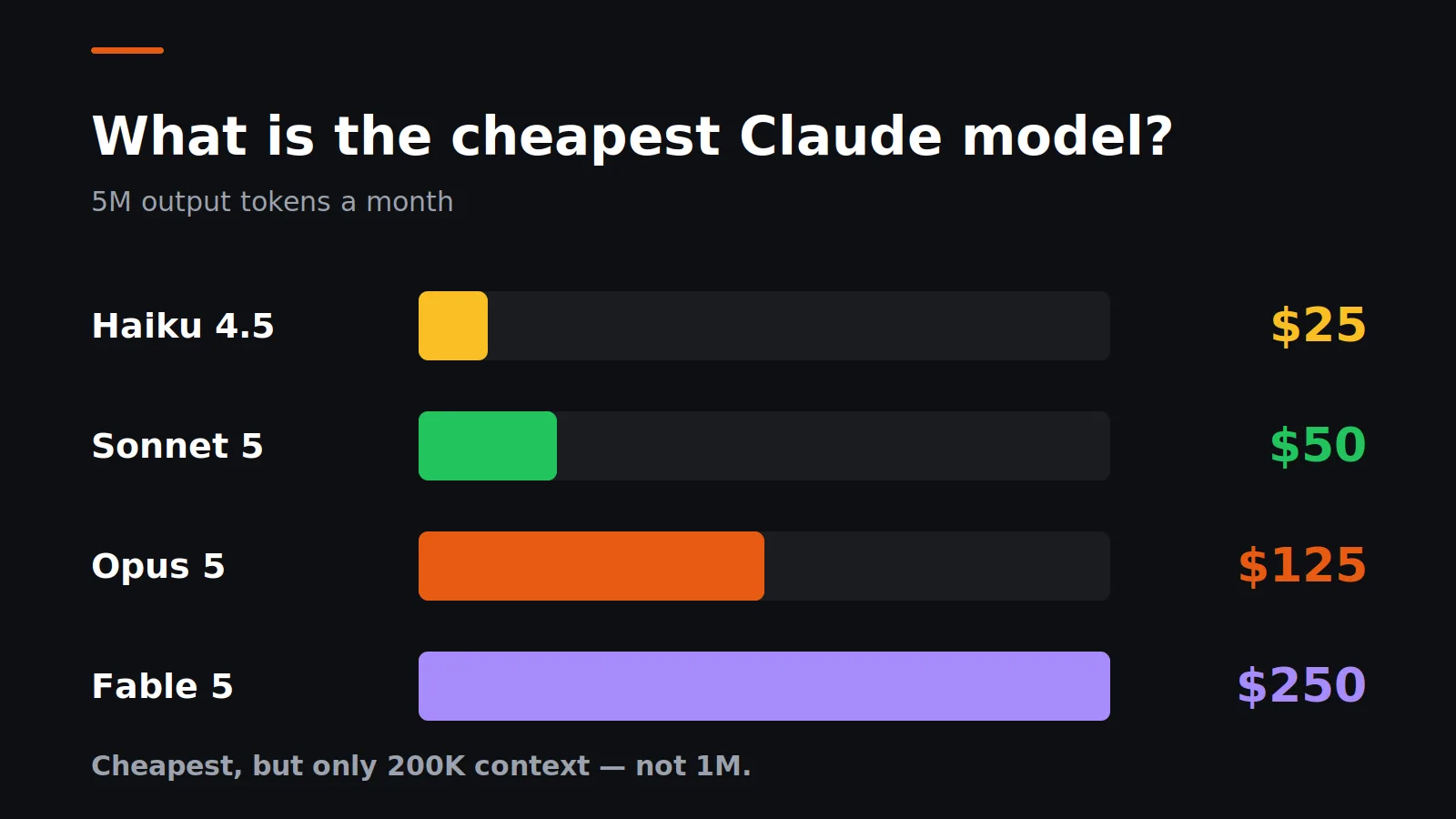
Answer: Haiku 4.5 at $1/$5 per million tokens. On 5 million output tokens a month, Haiku costs roughly $25, Sonnet 5 about $50, Opus 5 about $125, and Fable 5 about $250.
| Model | 5M output tokens / month |
|---|---|
| Fable 5 | ~$250 |
| Opus 5 | ~$125 |
| Sonnet 5 | ~$50 |
| Haiku 4.5 | ~$25 |
Output-only, list pricing, illustrative.
Notice that output tokens cost five times what input tokens cost on every tier. That means output-heavy work — long drafting, code generation, detailed reports — is where your tier choice hits the bill hardest. A model that reads a lot and writes a little is cheap on any tier.
Two discounts change these numbers materially. Batch API requests are 50% off input and output. Prompt cache reads cost 10% of the base input price. If your workload repeats a long system prompt, caching alone can move the decision.
But price per token is the wrong metric. The number that actually matters is:
Cost per successful task = model spend + retries + tool failures + human review + cost of mistakes
A cheaper model that needs three attempts and a human fix is more expensive than one call to a pricier model. Run both on the same job, with the same prompt, tools and definition of done, and count total cost — not token cost.
You can model your own volumes with our LLM Token Cost Calculator, compare every current model side by side in the AI Model Comparison Table, or estimate a full integration with the API Cost Calculator.
What is the best Claude model for coding?
Answer: Sonnet 5 handles most everyday coding well. Opus 5 is worth the premium for unfamiliar repositories, architecture decisions and subtle production failures.
Anthropic describes Opus 5 as a step-change over Opus 4.8, with the largest gains in deep reasoning, agentic and long-horizon tasks. On CursorBench 3.2 it lands within half a percent of Fable 5 at half the cost per task, which is the clearest coding signal in the published set.
A warning about benchmark claims, including ones you will read elsewhere. SWE-bench Verified and SWE-bench Pro are different tests, and many articles quote a score from one while linking the other — or attribute a number to Anthropic that Anthropic never published. If you see a confident “Opus 5 scores X% on SWE-bench” with no named benchmark and no link, treat it as unsourced. We only quote figures we can point you at.
The practical split:
- Sonnet 5 — scoped features, familiar refactors, writing tests, issue triage, reproducible bugs
- Opus 5 — architecture changes, unfamiliar codebases, cross-service changes, bugs where a superficial patch is worse than no patch
If you are shipping a product on top of these models rather than using them internally, model choice is one decision among many — the rest of that ground is what our SaaS product development work covers.
API differences that catch people out
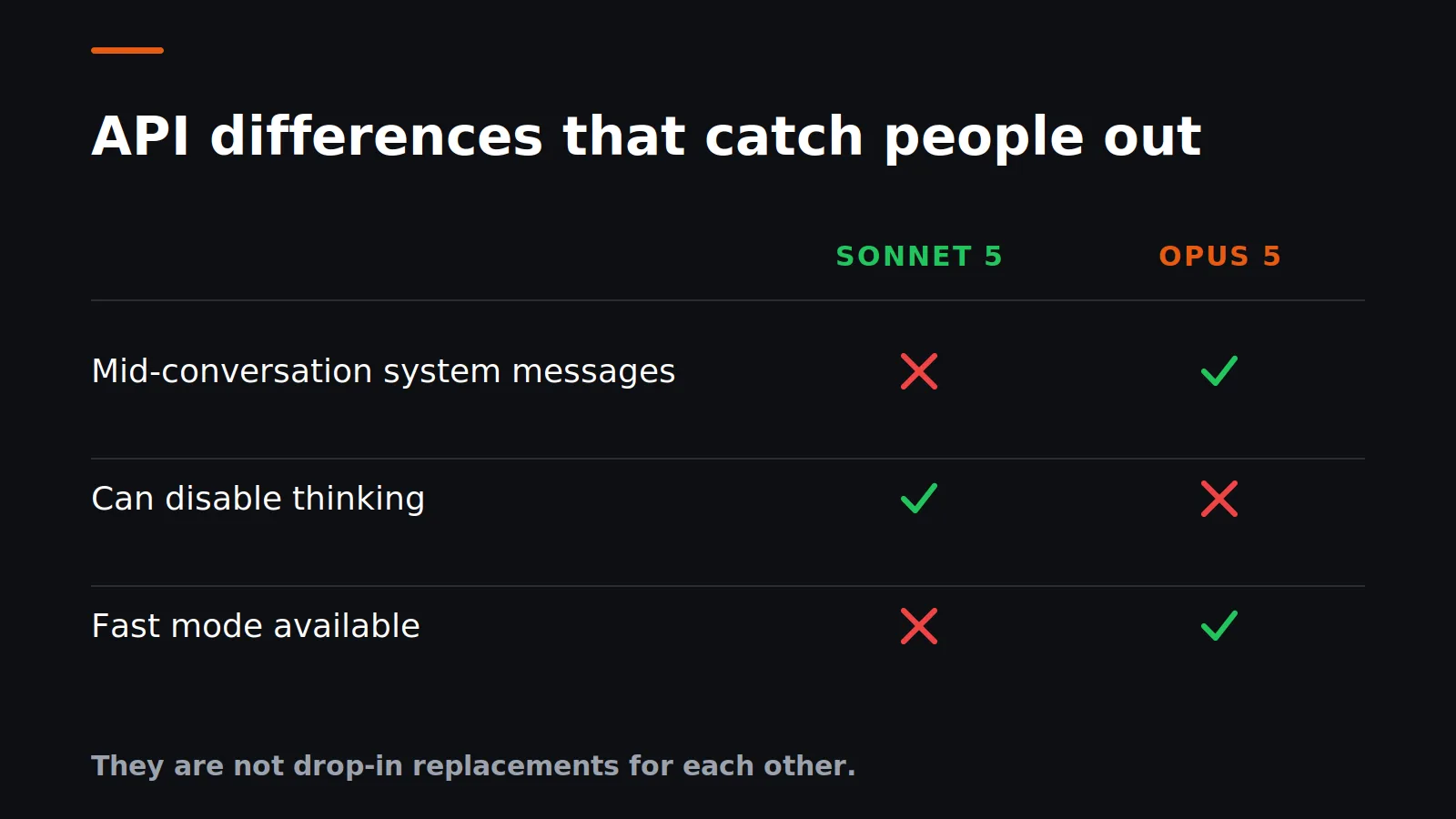
Answer: Opus 5 and Sonnet 5 are not drop-in replacements for each other. Several API behaviours differ in ways that break code on swap.
This is the section most comparisons skip, and it is where real migrations go wrong:
| Behaviour | Sonnet 5 | Opus 5 |
|---|---|---|
| Mid-conversation system messages | Not supported | Supported |
| Disabling thinking | Accepted | Only at effort high or below |
| Fast mode (research preview) | Not available | Available, priced at $10 / $50 |
That middle row is the one that bites. Thinking is on by default on Opus 5, and if you carry forward a configuration from Opus 4.8 that disables thinking while setting effort to xhigh or max, the request is rejected. Anthropic’s own migration notes flag it as a breaking change.
Check the full tool path before you change a model ID in production, and re-test effort settings rather than assuming they carry over.
What about Claude Mythos 5?
Answer: Mythos 5 is a limited-availability model with the same capabilities, pricing and API surface as Fable 5, released under Anthropic’s Project Glasswing. It is restricted to approved organisations and is not something a normal business can buy.
Anthropic’s own evaluations describe the difference in narrow terms rather than as a blanket removal of safety measures. On OSS-Fuzz cybersecurity testing, for example, Opus 5 comes close to Mythos 5 at identifying vulnerabilities but is considerably less successful at developing exploits.
Fable 5 ships with safeguards covering areas such as biology, cybersecurity and AI development. When one fires, the request returns a refusal rather than an answer. Anthropic offers an opt-in server-side fallback so a refused request can be routed to another model automatically — but you have to enable it; it is not default behaviour. That is worth knowing before you assume a Fable 5 deployment will always return a Fable 5 answer.
One piece of history that matters for planning. On 12 June 2026 the US government applied export controls to Fable 5 and Mythos 5, and Anthropic suspended access to both worldwide because it had no reliable way to verify user nationality in real time. The controls were lifted on 30 June and Fable 5 returned on 1 July — a 19-day outage. Anthropic has published the full account. Neither model was deprecated, but if a single model is a hard dependency in your stack, that is the risk in one sentence.
Which Claude model is best for business?
Answer: The one that finishes your specific job at the lowest total cost — which is rarely the same model for every task in your stack.
The most common mistake we see is a business picking one model, wiring it into everything, and either overpaying on simple tasks or under-delivering on hard ones. Model routing — sending each task to the cheapest model that reliably completes it — usually cuts spend by more than any negotiation on rates. In practice that routing rarely lives in the model call itself — it sits in the surrounding workflow automation, next to the retries, logging and human handoffs that decide whether a run actually finishes.
A workable routing setup:
- Haiku 4.5 — inbound email classification, data extraction, tagging, first-pass triage
- Sonnet 5 — customer replies, report generation, scoped code changes, recurring research
- Opus 5 — anything a human would escalate: unclear requirements, conflicting data, high-stakes analysis
- Fable 5 — long unattended agent runs where a failure is costly
This is the same principle behind the automation work in our case studies — the win is almost never a better model, it is the right model in the right place. If you are unsure which of your workflows belongs where, that is exactly what our AI Integrations service exists to work out.
Frequently asked questions
Which Claude model is the newest?
Claude Opus 5, released 24 July 2026. It replaced Opus 4.8 at the same price of $5/$25 per million tokens, making it a straight upgrade rather than a new pricier tier.
Do all Claude models have a 1M context window?
No. Fable 5, Opus 5 and Sonnet 5 have 1M. Haiku 4.5 has 200K with a 64K output limit.
Did Claude Sonnet 5 get more expensive on 1 September 2026?
No. Sonnet 5 launched at $2/$10 as introductory pricing through 31 August 2026, with an increase to $3/$15 scheduled for 1 September. Anthropic cancelled that increase in August and made $2/$10 the standard price. Several comparison articles still show the old figure.
Is Opus 5 better than Opus 4.8?
Yes, at the same price. Anthropic reports Opus 5 more than doubling Opus 4.8’s performance on Frontier-Bench v0.1. It also records the lowest rate of misaligned behaviour of any recent Claude model on Anthropic’s automated audit, scoring 2.3 — ahead of Fable 5, Sonnet 5 and Opus 4.8 itself.
Which Claude model has the most recent knowledge?
Opus 5, with a May 2026 cutoff. Fable 5 and Sonnet 5 both stop at January 2026, and Haiku 4.5 at February 2025.
When does Haiku 4.5 retire?
Anthropic commits to keeping it available until no sooner than 15 October 2026. Every other current model runs to mid-2027 or later. If Haiku 4.5 is in production for you, plan the move now.
Can I use more than one Claude model?
Yes, and most efficient setups do. Route routine work to Sonnet 5 or Haiku 4.5 and escalate difficult jobs to Opus 5.
The bottom line
There is no single best Claude model, and any page claiming one is selling something. Fable 5 leads on the hardest autonomous work. Opus 5 delivers close to it at half the price and is the sensible flagship for most teams. Sonnet 5 is the everyday workhorse. Haiku 4.5 handles volume — for another six weeks at least, on Anthropic’s current commitment.
Start one tier lower than you think you need. Measure cost per successful task rather than price per token. Escalate only where it changes the outcome.
If you would rather not manage that routing by hand, we build it — model selection, integration, and cost controls wired into the workflows you already run.
If you are weighing Claude against OpenAI rather than choosing within the Claude line, see Claude Opus 4.8 vs GPT-5.5.