AI Agents vs Traditional Automation: What Should Businesses Use?
Most growing businesses already automate something. Invoices go out when an order closes, new leads land in the CRM, and reports build themselves on schedule. Even so, employees still spend hours reading emails, reviewing documents, evaluating leads, and handling the odd cases that don’t fit the script. That gap is why so many teams are now weighing AI agents against the traditional automation they already rely on. Here’s the direct answer. Traditional automation works best for predictable, rule-based processes, while AI agents are more useful for flexible workflows that need interpretation and contextual decisions. However, for many businesses, combining both — with human oversight — delivers the best balance of reliability, intelligence, scalability, and control. 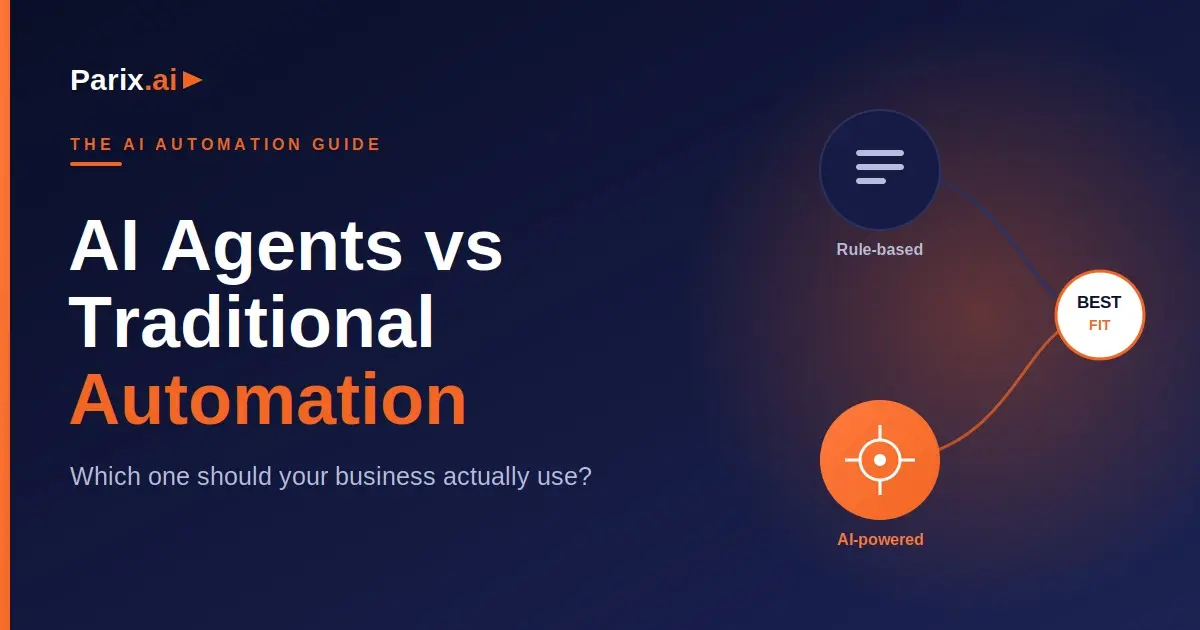
What Is Traditional Automation?
Traditional automation uses predefined rules, triggers, conditions, and actions to perform repetitive tasks. It runs on fixed workflows and structured data, so the same input reliably produces the same output. It spans scripts and macros, workflow automation tools, system integrations, robotic process automation (RPA), and simple trigger-and-action sequences. You’ve almost certainly used it: sending an invoice after a completed order, adding form submissions to a CRM, sending appointment reminders, updating spreadsheets or databases, assigning tasks automatically, generating scheduled reports, and moving data between business applications. When a process is stable and clearly defined, this approach is fast, affordable, and dependable. Many of these steps rely on solid AI integrations that connect the tools a business already uses.
What Are AI Agents?
An AI agent is a software system designed to work toward a defined goal. Rather than following only fixed rules, it can interpret information, choose an appropriate action within set limits, use connected tools, and complete multi-step tasks. In simple terms, it’s automation that can read context and decide the next move. In practice, an AI agent can read emails and documents, interpret customer requests, categorize information, generate drafts, and select the next workflow step. It can work across your CRM, email, and project tools, request human approval, and escalate unusual situations. Meta’s Muse for Small Business works this way: it connects to Instagram, Meta ads, Shopify and QuickBooks, then waits for your approval before acting. For example, a support agent might use a ready chatbot script as a starting point, then adapt replies to each customer. Just as important, AI agents still need clear instructions, scoped permissions, monitoring, and human oversight. They are not automatically autonomous or always accurate.
AI Agents vs Traditional Automation: Key Differences
| Factor | Traditional Automation | AI Agents |
|---|---|---|
| Decision-making | Fixed rules and logic | Interprets context, decides within limits |
| Workflow structure | Linear, predefined | Multi-step, adaptive |
| Data handled | Structured | Structured and unstructured |
| Handling exceptions | Poor | Stronger |
| Flexibility | Low | High |
| Predictability | Very high | Moderate; needs validation |
| Personalization | Limited | Strong |
| Workflow complexity | Simple | Complex |
| Human oversight | Minimal after testing | Recommended, especially for sensitive tasks |
| Setup difficulty | Lower | Higher |
| Maintenance | Rule updates | Monitoring and testing |
| Security risks | Well understood | Needs scoped access and logging |
| Cost | Lower for repetitive work | Higher setup plus model/API costs |
| Best use cases | Stable, rule-based tasks | Variable, judgment-based tasks |
| Scalability | Excellent for fixed tasks | Strong for varied tasks |
The core difference is judgment. Traditional automation executes decisions you’ve already made, whereas an AI agent can make bounded decisions in the moment. As a result, agents are powerful for messy, variable work — and that’s why they need oversight that simple automation doesn’t.
Benefits of Traditional Automation
Traditional automation remains highly valuable. Indeed, it’s reliable and consistent, produces predictable outputs, and is easy to test and quality-check. Furthermore, it carries lower complexity, deploys quickly, and gives you strong control over every step. For repetitive tasks it’s cost-effective, easier to monitor for compliance, and consistent at scale. Overall, for stable, structured work, it’s still the right tool.
Limitations of Traditional Automation
Its weaknesses appear when work becomes unpredictable. For instance, it struggles with unexpected situations, depends entirely on predefined rules, and can’t interpret emails, documents, or natural language well. Moreover, when a process changes, the rules need updating, and large rule sets get hard to manage. A quick example shows the problem. An automation that adds form leads to your CRM works perfectly — until someone submits an incomplete form or writes their request in an unusual format. In that case, the rule has no way to interpret what’s missing, so the lead either gets mishandled or dropped. Therefore, that’s the moment interpretation starts to matter.
Benefits of AI Agents for Business
AI agents shine on unstructured, multi-step work. For example, they can process free-form information, handle flexible workflows, and support contextual decisions. In addition, they summarize and categorize data, create personalized outputs, and coordinate tasks across several tools. As a result, agents reduce repetitive review work, help employees prepare decisions, and escalate sensitive cases to a person. Still, they don’t remove all manual effort — instead, they reduce it and tee up better decisions.
Risks and Limitations of AI Agents
This deserves equal attention. For one thing, AI agents can produce incorrect interpretations or inconsistent outputs, and they are less predictable than rule-based systems. In addition, they raise data-privacy concerns, permission and security risks, and compliance questions, and they depend on external models and APIs. On top of that, they add implementation complexity and require ongoing monitoring and fallback processes.
Responsible implementation practices
Fortunately, a few practices keep these risks in check. First, grant minimum necessary access, use role-based permissions, keep activity logs, and add human approval checkpoints. Next, validate outputs, test with edge cases, and set clear escalation rules and data-handling policies. Finally, review performance regularly so problems surface early.
When Should Businesses Use Traditional Automation?
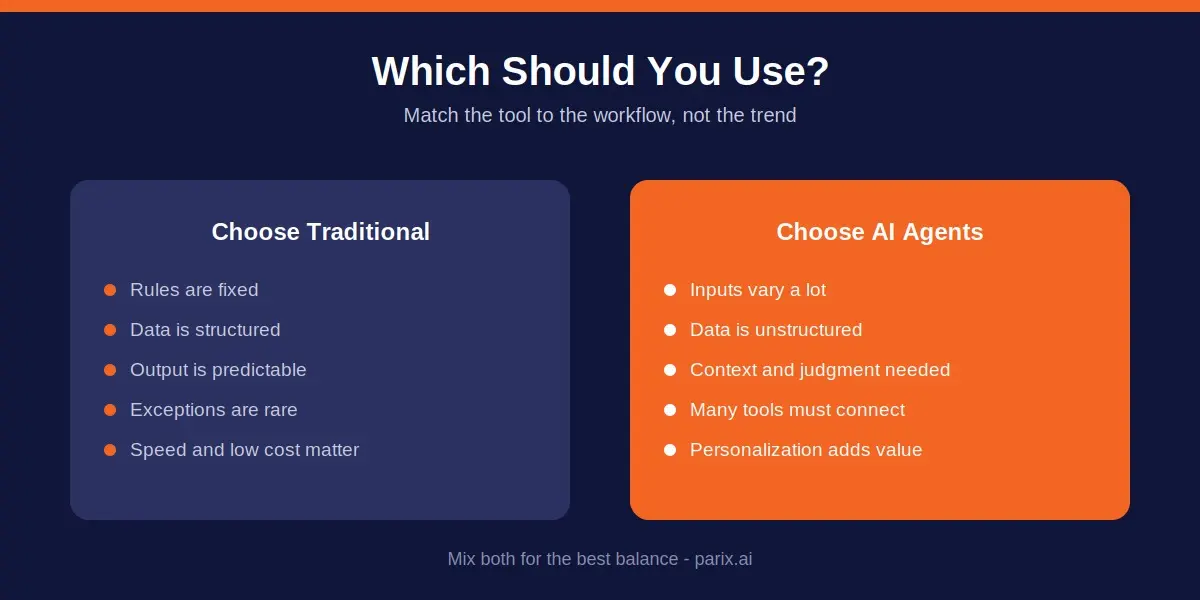
Use traditional automation when the process follows fixed rules and the output must be predictable. Specifically, it fits when inputs are structured, exceptions are uncommon, the task repeats often, and speed and affordability are priorities — with little interpretation needed. For example, common examples include recurring invoicing, inventory updates, scheduling reminders, CRM management, reporting, and notifications.
When Should Businesses Use AI Agents?
Use AI agents when employees currently have to interpret emails, messages, or documents, or when the workflow needs contextual decisions. In particular, they fit when inputs vary widely, several tools must work together, personalization matters, or research and summarization are required — and where human approval can sit before important actions. For example, strong use cases include sales lead qualification, customer support triage, proposal preparation, document processing, financial document review, and recruitment support. 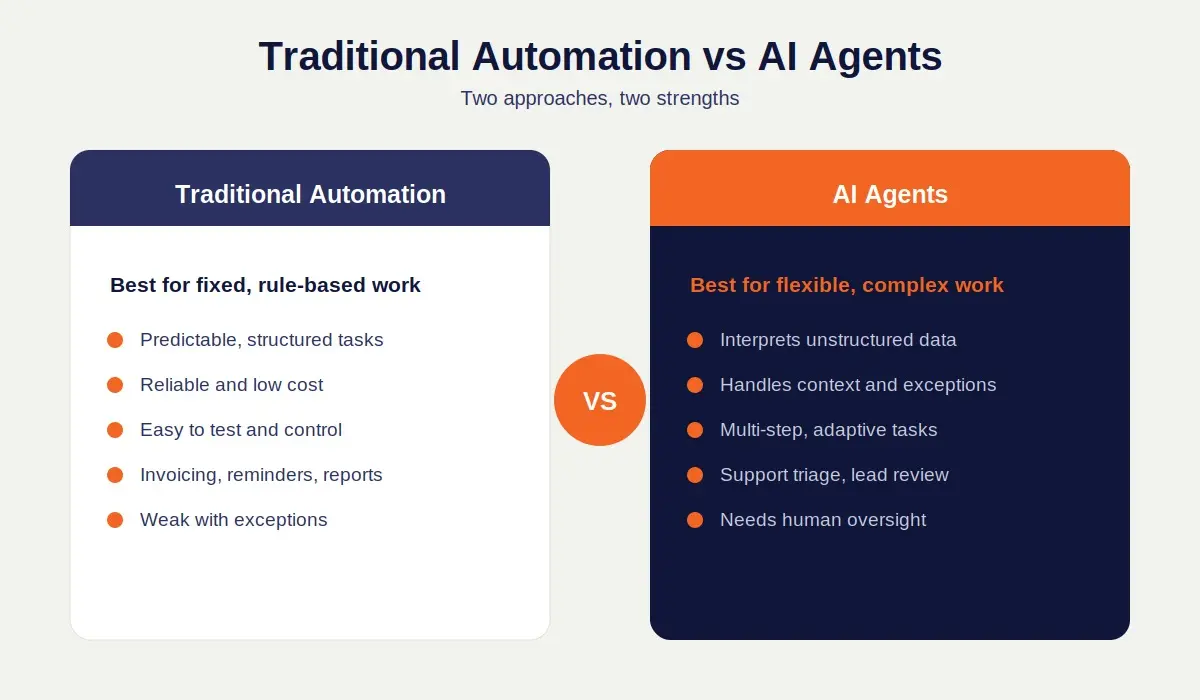
Should Businesses Combine AI Agents and Traditional Automation?
For many teams, a hybrid approach is the most practical option — and a lead workflow shows why. First, traditional automation captures a website lead, validates the required fields, adds the contact to the CRM, and creates a follow-up task. Next, an AI agent reviews the lead’s message, identifies the likely service need, researches relevant company details, drafts a personalized response, and sends it to a salesperson for approval. Finally, once approved, traditional automation sends the message, updates the CRM, schedules the next follow-up, and records the activity.
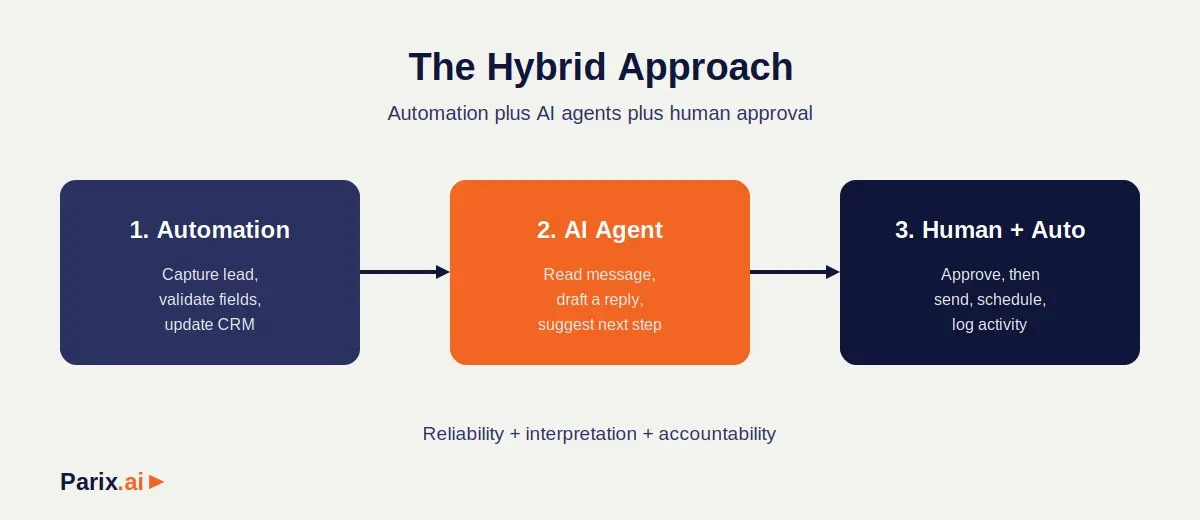
Each part plays a clear role. Traditional automation provides reliability and structure, the AI agent provides interpretation and flexibility, and human approval provides accountability and risk control. Building this kind of hybrid flow depends on reliable workflow automation and system integrations that let each tool hand off to the next.
How to Choose the Right Automation Approach
A simple framework keeps the decision grounded:
- Map the complete workflow.
- Identify triggers, inputs, decisions, actions, and outputs.
- Find the repetitive, time-consuming steps.
- Separate rule-based tasks from judgment-based tasks.
- Determine whether the data is structured or unstructured.
- Identify exceptions and edge cases.
- Assess security, privacy, and compliance risks.
- Decide where human approval is necessary.
- Estimate implementation and maintenance effort.
- Select one valuable workflow for a pilot, test normal and unusual scenarios, and measure accuracy, time savings, errors, adoption, and business impact.
In short: choose traditional automation when predictability matters most, choose AI agents when interpretation and flexibility matter most, and choose a hybrid when the workflow includes both. If you’re not sure where to begin, our free Automation Idea Generator can help you spot the highest-impact workflow to automate first.
Common Automation Mistakes Businesses Should Avoid
Don’t automate a broken process — fix it first. Avoid choosing AI just because it’s popular, or using it where simple automation would do. Don’t give agents excessive system access or remove human approval too early. Watch out for ignoring exceptions, automating too many workflows at once, skipping measurable outcomes, neglecting employee training, and failing to monitor the system after launch.
Final Verdict: What Should Businesses Use?
Traditional automation is best for predictable, stable, and structured processes. In contrast, AI agents are valuable for complex, flexible, and information-heavy workflows. Ultimately, for most businesses, a hybrid model is the strongest option. Therefore, choose technology based on workflow requirements, risk, data, budget, and goals — not on trends — and start with one clearly defined problem rather than automating everything at once. This is where Parix.ai helps. We map current workflows, identify automation opportunities, separate rule-based tasks from AI-suitable ones, build AI agents, connect your business applications, add human-approval stages, and implement secure AI-powered workflow automation you can monitor and improve. You can also start on your own with our free AI tools. If you can name one workflow that’s repetitive, expensive, or slow, that’s the ideal place to start — reach out and we’ll help you evaluate it. Related reading: AI Agents for Business: Practical Use Cases — a closer look at where AI agents deliver the most value across sales, support, and operations.
FAQ
What is the difference between AI agents and traditional automation?
Traditional automation follows fixed rules to handle predictable, structured tasks the same way every time. AI agents interpret context, work with unstructured information, and make bounded decisions across multiple steps. Traditional automation executes predefined logic, while AI agents reason within approved limits and adapt to what they find.
Are AI agents better than traditional automation?
Neither is universally better; they solve different problems. Traditional automation wins on reliability, cost, and control for stable, rule-based work. AI agents win on flexibility and interpretation for variable, document-heavy tasks. Many businesses get the best results by combining both, with human approval for sensitive actions.
Can small businesses use AI agents?
Yes. Small businesses often benefit most because they have fewer people to handle repetitive interpretation work. Starting with one well-defined workflow, such as lead qualification or support triage, keeps cost and risk manageable while proving value before expanding to other processes.
Are AI agents more expensive than traditional automation?
Usually, yes. AI agents cost more to set up and run because of model, API, and monitoring needs, while traditional automation is cheaper for repetitive tasks. The better question is which delivers more value for a specific workflow. You can estimate a realistic budget with our free AI Automation Cost Calculator before you commit.
Can AI agents work with traditional automation tools?
Yes. AI agents usually sit alongside your existing automation rather than replacing it. A common pattern is traditional automation handling structured steps and integrations, while an AI agent adds interpretation or drafting in the middle, and the workflow continues automatically after any required human approval.
Which business processes should not be fully automated with AI?
High-stakes or sensitive decisions — final financial approvals, legal commitments, hiring choices, or anything with strong compliance and privacy implications — shouldn’t be fully handed to an AI agent. These belong in a human-in-the-loop setup where the agent prepares the work and a person reviews and approves before action.