UI/UX Branding in 2026: Designing Digital Products People Actually Trust
Branding stopped being just a logo and a color palette a long time ago. These days, most people meet your brand through something you built, a website, a web app, a mobile app, and the way that product feels in their hands is the brand, as far as they’re concerned. That’s why UI/UX branding has quietly become one of the biggest factors in whether someone trusts a company or quietly clicks away.
And it’s about a lot more than making things look nice. UI/UX branding is what happens when your brand identity and your design decisions stop living in separate worlds and start working as one. Let’s break down what that means, why it builds trust, what’s changing in 2026, and where it matters most.
What UI/UX Branding Really Means
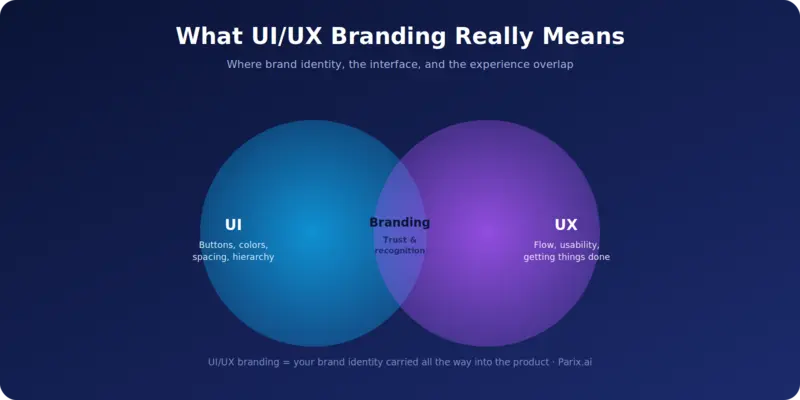
At its simplest, UI/UX branding is your brand identity carried all the way into the design of a digital product. The layout, the typeface, the colors, the little micro-interactions, the path a user takes from one screen to the next, all of it should feel like the same brand talking, not a patchwork of unrelated decisions.
It helps to separate the two halves first. UI is the surface, the buttons, icons, spacing, and visual order you see and tap. UX is the deeper question of whether the thing actually works and gets you where you wanted to go, and the team at Nielsen Norman Group describes user experience as covering every part of a person’s interaction with a company and its products.
Branding is the thread that ties UI and UX together so the product is recognizable and reassuring at the same time. When it’s done well, a user clocks who they’re dealing with and feels safe using the product, which matters even more on a small screen. This is the heart of what good branding and UI/UX design is meant to deliver.
Why UI/UX Branding Builds Trust
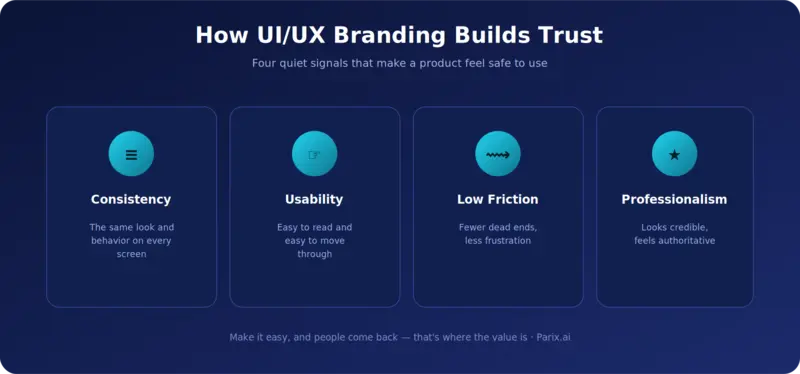
Trust is built on consistency and follow-through. People decide very quickly whether a product feels reliable and professional, and if the look and the behavior don’t line up, that doubt sets in fast. Strong UI/UX branding earns trust in a few quiet ways:
- Visual and behavioral consistency across every screen
- Interfaces that are easy to read and easy to move through
- Less friction, fewer dead ends, less frustration
- A sense of professionalism and authority that makes people comfortable
This isn’t a soft, feel-good claim either, the money follows the design. In its widely cited study, McKinsey found that companies in the top quartile for design grew revenue 32% faster and delivered 56% higher returns to shareholders than their peers over five years. Make the experience easy and people come back, and coming back is where the value is.
UI/UX Branding vs Visual Branding
It’s worth being clear about the difference, because they often get lumped together. Visual branding is the logo, the color scheme, the marketing materials, it answers the question “what does the brand look like?”
UI/UX branding takes all of that and pushes it into the actual product and the way people use it. It answers a different and harder question: “what does the brand feel like to use?” A logo can be gorgeous, but if the signup flow is confusing, the brand still feels broken. That’s the gap UI/UX branding closes.
Where UI/UX Branding Matters Most
Plenty of businesses benefit from this, but a few feel it more sharply than others. Any company launching its first real digital product needs it from day one, and for most of them that starts with the website, where solid web development and design set the first impression.
Mobile is where it gets even less forgiving, since there’s no room to hide a clumsy experience on a small screen. Consistent, well-branded mobile app design is often the difference between an app people keep and one they delete in a week.
Then there are SaaS products, where the whole business depends on people sticking around month after month. Thoughtful design is one of the strongest levers for retention, which is why it sits at the core of good SaaS product development. Online stores chasing conversions and older businesses modernizing tired systems land in the same camp.
UI/UX Branding in 2026
So what’s actually changing this year? The fundamentals haven’t moved, but a few shifts are reshaping how UI/UX branding gets done in 2026: 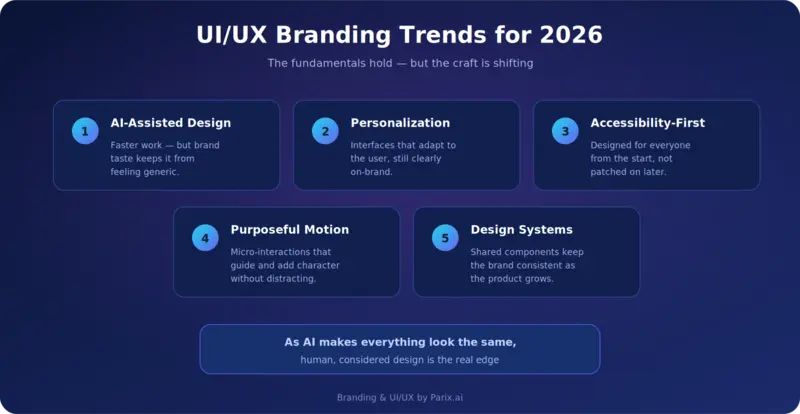
- AI-assisted design: teams use AI to move faster, but the brand’s judgment and taste are what keep the work from feeling generic.
- Personalization: interfaces that adapt to the individual user, while still feeling unmistakably like the same brand.
- Accessibility-first: designing for everyone from the start, not patching it on at the end.
- Purposeful motion: micro-interactions and animation that guide people and add personality without getting in the way.
- Design systems: shared component libraries that keep a brand consistent as a product grows.
Accessibility deserves a special mention, because in 2026 it’s no longer optional or a nice-to-have. Following the W3C’s accessibility guidance widens your audience and signals that your brand actually respects the people using it, which is its own kind of trust.
There’s also a bigger shift worth naming. As AI floods the web with generic, samey interfaces, a product that feels genuinely human and considered stands out more than ever, and resources like the Interaction Design Foundation are a good place to keep sharpening that craft. Good design is becoming a competitive edge precisely because so much of what’s being shipped now feels flat and interchangeable.
What It Looks Like in Practice
The theory only means something when you see it in a real product. When we built the Design Pro project management workspace, the brief wasn’t just to make it work, it was to make a tool with a lot of moving parts still feel calm, clear, and consistent to use, and you can see how that played out in the Design Pro case study. That’s UI/UX branding doing its job: capability that doesn’t come at the cost of clarity.
How Parix.ai Helps
At Parix.ai, we treat branding and design as part of building the product, not a coat of paint added at the end. We carry your brand identity all the way through the interface and the experience, so the final product looks right, feels right, and earns trust the moment someone opens it. If you’re thinking bigger picture, our guide on SaaS product development strategy is a useful companion read.
Conclusion
UI/UX branding was never really about aesthetics. It’s about building trust and making products people genuinely enjoy using, the kind they come back to. In a crowded, increasingly AI-generated digital world, the brands that pair a strong experience with a consistent identity are the ones that will stand out and stick. If that’s the kind of product you want to build, get in touch with Parix.ai.
FAQs
What is UI/UX branding? It’s your brand identity applied all the way through the design of a digital product, the layout, colors, typography, interactions, and user flow, so the experience consistently looks and feels like your brand.
How is UI/UX branding different from a logo or visual branding? Visual branding is how the brand looks, the logo, colors, and marketing. UI/UX branding is how the brand feels to use inside the actual product. One answers “what does it look like?”, the other answers “what’s it like to use?”
Does UI/UX branding really affect business results? Yes. Research from McKinsey links strong design to faster revenue growth and higher shareholder returns. Better experiences keep users around, lift conversions, and cut support headaches.
Why does UI/UX branding matter more in 2026? As AI fills the web with generic, look-alike interfaces, a product that feels human, consistent, and accessible stands out far more. Good design is becoming a real competitive advantage.
Which businesses need UI/UX branding most? Companies launching their first digital product, SaaS platforms focused on retention, online stores chasing conversions, and established businesses modernizing older systems all benefit the most.
Consistency across every touchpoint is most of what makes a product feel trustworthy. Our free Brand Style Guide Compiler turns your colors, fonts, and voice into one reference doc your whole team can design from.